The ack, the order’s new state, the next event and tomorrow’s reminder commit as one log entry, or none of them does. That one call replaces the outbox table, the idempotency table and the cron job.
await queen.queue('orders')
  .group('fulfillment')
  .subscriptionMode('all')
  .autoAck(false)
  .each()
  .limit(1)
  .consume(async (msg) => {
    const { orderId, customer } = msg.data
    await queen.transaction()
      .ack(msg, 'completed', { consumerGroup: 'fulfillment' })  // the input is done
      .kv.put('orders', `order-${orderId}`, { status: 'paid' }, { ttl: '7d' })
      .queue('shipments').partition(msg.partition)              // the next event
      .push([{ transactionId: `ship-${orderId}`, data: { orderId } }])
      .timer('reminders').key(`review-${orderId}`).delay('24h') // a message tomorrow
      .payload({ orderId, customer }).schedule()
      .commit()
  })
from datetime import timedelta
async def fulfil(msg):
order_id, customer = msg["data"]["orderId"], msg["data"]["customer"]
await (
queen.transaction()
.ack(msg, "completed", {"consumer_group": "fulfillment"}) # the input is done
.kv.put("orders", f"order-{order_id}", {"status": "paid"}, ttl=timedelta(days=7))
.queue("shipments").partition(msg["partition"]) # the next event
.push([{"transactionId": f"ship-{order_id}", "data": {"orderId": order_id}}])
.timer("reminders").key(f"review-{order_id}").after(timedelta(hours=24)) # tomorrow
.payload({"orderId": order_id, "customer": customer}).schedule()
.commit()
)
await (
queen.queue("orders")
.group("fulfillment")
.subscription_mode("all")
.auto_ack(False)
.each()
.limit(1)
.consume(fulfil)
)err = client.Queue("orders").
Group("fulfillment").
SubscriptionMode(queen.SubscriptionModeAll).
AutoAck(false).
Each().
Limit(1).
Consume(ctx, func(ctx context.Context, msg *queen.Message) error {
orderID := fmt.Sprint(msg.Data["orderId"])
_, err := client.Transaction().
Ack(msg, queen.AckStatusCompleted, queen.AckOptions{ConsumerGroup: "fulfillment"}). // the input is done
KV(queen.KVPutOp("orders", "order-"+orderID, // the order's state
map[string]interface{}{"status": "paid"}, queen.TTL(7*24*time.Hour))).
Queue("shipments").Partition(msg.Partition). // the next event
Push(queen.PushItem{TransactionID: "ship-" + orderID, Payload: map[string]interface{}{"orderId": orderID}}).
Timers(queen.ScheduleTimerOp(queen.TimerSchedule{ // a message tomorrow
Queue: "reminders", TimerKey: "review-" + orderID, Delay: 24 * time.Hour,
Payload: map[string]interface{}{"orderId": orderID, "customer": msg.Data["customer"]},
})).
Commit(ctx)
return err
}).
Execute(ctx)
if err != nil {
log.Fatal(err)
}use queen_mq::{Expiry, TxnPushItem};
let client = queen.clone();
queen
.queue("orders")
.group("fulfillment")
.subscription_mode(SubscriptionMode::All)
.auto_ack(false)
.limit(1)
.consume(move |msg: Message| {
let client = client.clone();
async move {
let id = &msg.data["orderId"];
client
.transaction()
.ack(&msg) // the input is done
.kv_put("orders", &format!("order-{id}"), json!({ "status": "paid" }),
Expiry::Seconds(7 * 86400))? // the order's state
.push_item(TxnPushItem { // the next event, same customer
queue: "shipments".into(),
partition: Some(msg.partition.clone()),
payload: json!({ "orderId": id }),
transaction_id: Some(format!("ship-{id}")),
trace_id: None,
})?
.schedule("reminders", &format!("review-{id}"), Duration::from_secs(86400), // a message tomorrow
json!({ "orderId": id, "customer": msg.data["customer"] }).to_string())
.commit()
.await?;
Ok::<_, queen_mq::Error>(())
}
})
.await?;$queen->queue('orders')
->group('fulfillment')
->subscriptionMode('all')
->autoAck(false)
->each()
->limit(1)
->consume(function (array $msg) use ($queen) {
$id = $msg['data']['orderId'];
$queen->transaction()
->ack($msg, 'completed', ['consumerGroup' => 'fulfillment']) // the input is done
->kv('orders')->put("order-{$id}", ['status' => 'paid'], ['ttlSeconds' => 7 * 86400])
->queue('shipments')->partition($msg['partition']) // the next event
->push([['transactionId' => "ship-{$id}", 'data' => ['orderId' => $id]]])
->timers('reminders')->schedule("review-{$id}", 24 * 3600 * 1000, // tomorrow, in ms
['orderId' => $id, 'customer' => $msg['data']['customer']])
->commit();
})
->execute();client.queue("orders")
.group("fulfillment")
.subscription_mode("all")
.auto_ack(false)
.each()
.limit(1)
.consume([&](const json& msg) {
const json& order = msg["data"];
const std::string id = std::to_string(order["orderId"].get<int>());
queen::TimerSchedule reminder; // a message tomorrow
reminder.queue = "reminders";
reminder.timer_key = "review-" + id;
reminder.delay_millis = 24 * 60 * 60 * 1000;
reminder.payload = {{"orderId", order["orderId"]},
{"customer", order["customer"]}};
// client.transaction() cannot give its push a partition, so the step goes
// to the broker's transaction route through the client's own HTTP layer.
json step = {
{"operations", json::array({
{{"type", "ack"}, {"status", "completed"}, // the input is done
{"consumerGroup", "fulfillment"}, {"leaseId", msg["leaseId"]},
{"transactionId", msg["transactionId"]},
{"partitionId", msg["partitionId"]}},
{{"type", "push"}, {"items", json::array({{ // the next event
{"queue", "shipments"}, {"partition", msg["partition"]},
{"transactionId", "ship-" + id},
{"payload", {{"orderId", order["orderId"]}}},
}})}},
})},
{"requiredLeases", json::array({msg["leaseId"]})},
{"kv", json::array({queen::wire::kv_write_op("put", "orders", "order-" + id,
{{"status", "paid"}}, queen::KvTtl::seconds(7 * 86400), {})})},
{"timers", json::array({queen::wire::timer_schedule_op(reminder)})},
};
client.get_http_client()->post("/api/v1/transaction", step);
});Then open the dashboard: its KV page holds the order’s new state, and its Timers page holds tomorrow’s reminder.
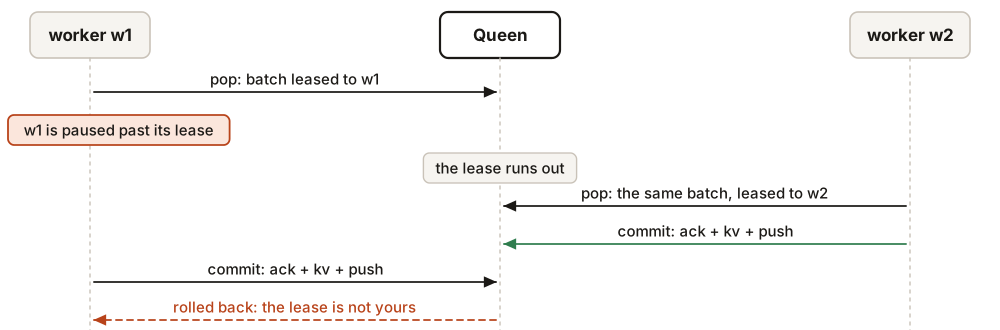
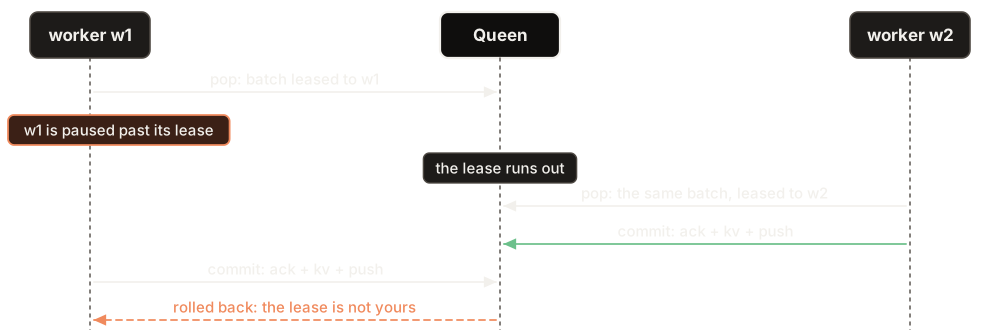
If the worker took too long and its lease ran out, the whole transaction is refused, so a slow worker can never write over the one that has the message now. If the step committed and only the answer got lost, a retry with the same transactionIds is refused whole, and nothing is written twice.
What can go in
| Part | What it can hold |
|---|---|
| Acks | Messages leased from any partitions, queues and consumer groups of the tenant. Each ack carries its group and the lease of the pop that delivered it. |
| Pushes | Messages to any queues and partitions. A queue or a partition that does not exist is created, as by a push. |
| KV | put, putIfAbsent, delete, incr and check, each one optionally with a condition (expect, required). |
| Timers | schedule, which replaces a timer with the same key, and cancel. |
| A guard | .guard(lock): the call commits only while the lock is still yours. |
Over HTTP the same call is POST /api/v1/transaction: the acks and pushes go in operations, the KV and timer parts in the top-level arrays kv and timers. Transaction API has every field.
Conditions instead of reads
A transaction is one call, not a session: there is no “read, decide, write”. To make a write depend on the state, put a condition on it. expect names the version the key must have, and required: true makes a missed condition roll back the whole call.
await queen.queue('order-events')
  .group('workflow')
  .subscriptionMode('all')
  .autoAck(false)
  .each()
  .consume(async (msg) => {
    const { orderId } = msg.data
    const order = await queen.kv.get('orders', orderId)            // { status: 'paid' }
    if (order.value.status !== 'paid') {                   // already moved: just ack
      return queen.ack(msg, 'completed', { group: 'workflow' })
    }

    // Do the work of this step here: charge the card, book the courier, ...

    const result = await queen.transaction()
      .ack(msg, 'completed', { consumerGroup: 'workflow' })
      .kv.put('orders', orderId, { status: 'shipping' },
        { ttl: '30d', expect: order.version, required: true })  // only from what we read
      .queue('shipping').partition(orderId)
      .push([{ transactionId: `ship-${orderId}`, data: { orderId } }])
      .commit()
    if (result.success === false) return  // moved by someone else: nothing written
  })
async def step(msg):
order_id = msg["data"]["orderId"]
order = await queen.kv.get("orders", order_id) # {'status': 'paid'}
if order["value"]["status"] != "paid": # already moved: just ack
return await queen.ack(msg, "completed", {"group": "workflow"})
# Do the work of this step here: charge the card, book the courier, ...
result = await (
queen.transaction()
.ack(msg, "completed", {"consumer_group": "workflow"})
.kv.put("orders", order_id, {"status": "shipping"},
ttl=timedelta(days=30), expect=order["version"],
required=True) # only from what we read
.queue("shipping").partition(order_id)
.push([{"transactionId": f"ship-{order_id}", "data": {"orderId": order_id}}])
.commit()
)
if not result: # moved by someone else: nothing written
return
await (
queen.queue("order-events")
.group("workflow")
.subscription_mode("all")
.auto_ack(False)
.each()
.consume(step)
)err = client.Queue("order-events").
Group("workflow").
SubscriptionMode(queen.SubscriptionModeAll).
AutoAck(false).
Each().
Consume(ctx, func(ctx context.Context, msg *queen.Message) error {
opts := queen.AckOptions{ConsumerGroup: "workflow"}
orderID := msg.Data["orderId"].(string)
order, err := client.KV().Get(ctx, "orders", orderID) // Value {"status":"paid"}
if err != nil {
return err
}
var state struct{ Status string }
if err := json.Unmarshal(order.Value, &state); err != nil {
return err
}
if state.Status != "paid" { // already moved: just ack
_, err := client.Ack(ctx, msg, true, opts)
return err
}
// Do the work of this step here: charge the card, book the courier, ...
next := map[string]interface{}{"status": "shipping"}
result, err := client.Transaction().
Ack(msg, queen.AckStatusCompleted, opts).
KV(queen.KVPutOp("orders", orderID, next, queen.TTL(30*24*time.Hour),
queen.KVWriteOptions{
Expect: queen.Expect(order.Version), // only from what we read
Required: true,
})).
Queue("shipping").Partition(orderID).
Push(queen.PushItem{TransactionID: "ship-" + orderID,
Payload: map[string]interface{}{"orderId": orderID}}).
Commit(ctx)
if err != nil {
return err
}
if result.IsKVPrecondition() {
fmt.Println(orderID, "moved by someone else: nothing written")
}
return nil
}).
Execute(ctx)
if err != nil {
log.Fatal(err)
}let client = queen.clone();
queen
.queue("order-events")
.group("workflow")
.subscription_mode(SubscriptionMode::All)
.auto_ack(false)
.consume(move |msg: Message| {
let queen = client.clone();
async move {
let order_id = msg.data["orderId"].as_str().unwrap_or_default().to_string();
let order = queen.kv().get("orders", &order_id).await?; // {"status":"paid"}
if order.value.as_ref().and_then(|v| v["status"].as_str()) != Some("paid") {
queen.ack(&msg).await?; // already moved: just ack
return Ok(());
}
// Do the work of this step here: charge the card, book the courier, ...
let thirty_days = Expiry::seconds(30 * 86400);
let shipping = queen
.kv()
.put("orders", &order_id, json!({ "status": "shipping" }), thirty_days)
.expect(order.version.unwrap_or(0)) // only from what we read
.required()
.operation()?;
let result = queen
.transaction()
.ack(&msg)
.kv(shipping)
.push_item(TxnPushItem {
queue: "shipping".into(),
partition: Some(order_id.clone()),
payload: json!({ "orderId": order_id }),
transaction_id: Some(format!("ship-{order_id}")),
trace_id: None,
})?
.commit()
.await?;
if !result.success {
return Ok(()); // moved by someone else: nothing written
}
Ok::<_, queen_mq::Error>(())
}
})
.await?;$queen->queue('order-events')
->group('workflow')
->subscriptionMode('all')
->autoAck(false)
->each()
->consume(function (array $msg) use ($queen) {
$orderId = $msg['data']['orderId'];
$order = $queen->kv()->get('orders', $orderId); // value: [status => paid]
if ($order['value']['status'] !== 'paid') { // already moved: just ack
$queen->ack($msg, 'completed', ['group' => 'workflow']);
return;
}
// Do the work of this step here: charge the card, book the courier, ...
$result = $queen->transaction()
->ack($msg, 'completed', ['consumerGroup' => 'workflow'])
->kv('orders')->put($orderId, ['status' => 'shipping'], [
'ttlSeconds' => 30 * 86400,
'expect' => $order['version'], // only from what we read
'required' => true,
])
->queue('shipping')->partition($orderId)->push([
['transactionId' => "ship-{$orderId}", 'data' => ['orderId' => $orderId]],
])
->commit();
if ($result['success'] === false) {
return; // moved by someone else: nothing written
}
})
->execute();client.queue("order-events")
.group("workflow")
.subscription_mode("all")
.auto_ack(false)
.each()
.consume([&](const json& msg) {
const std::string order_id = msg["data"]["orderId"];
json order = client.kv("orders").get(order_id); // value: {"status":"paid"}
if (order["value"]["status"] != "paid") { // already moved: just ack
client.ack(msg, true, {{"group", "workflow"}});
return;
}
// Do the work of this step here: charge the card, book the courier, ...
queen::KvWriteOptions from_what_we_read; // only from what we read
from_what_we_read.expect = order["version"].get<long long>();
from_what_we_read.required = true;
// client.transaction() cannot give its push a partition, so the step goes
// to the broker's transaction route through the client's own HTTP layer.
json step = {
{"operations", json::array({
{{"type", "ack"}, {"status", "completed"},
{"consumerGroup", "workflow"}, {"leaseId", msg["leaseId"]},
{"transactionId", msg["transactionId"]},
{"partitionId", msg["partitionId"]}},
{{"type", "push"}, {"items", json::array({{
{"queue", "shipping"}, {"partition", order_id},
{"transactionId", "ship-" + order_id},
{"payload", {{"orderId", order_id}}},
}})}},
})},
{"requiredLeases", json::array({msg["leaseId"]})},
{"kv", json::array({queen::wire::kv_write_op("put", "orders", order_id,
{{"status", "shipping"}}, queen::KvTtl::seconds(30 * 86400),
from_what_we_read)})},
};
json result = client.get_http_client()->post("/api/v1/transaction", step);
bool committed = result.value("success", false);
if (!committed) return; // moved by someone else: nothing written
});once(ns, key, { ttl }) (JavaScript and Python) is the short form of the most common condition: a marker written with putIfAbsent and required: true. Key it on the business fact (paymentId), and a second delivery of the same fact rolls back whole, receipts and timers included. The other SDKs write the same marker with KV putIfAbsent and required: true.
Why a transaction rolls back
A rollback answers HTTP 200 with success: false, a reason, and nothing written.
reason |
Cause |
|---|---|
rejected_ack |
An ack’s lease ran out or moved to another worker. The message goes to whoever holds it now. |
kv_precondition |
A condition with required: true failed: a once marker that exists, an expect that missed, a lock that is gone. |
duplicate |
A pushed transactionId is already in its partition’s dedup window: the step already committed. |
reserved |
Another write holds that cursor at this moment. Try again. |
bad_request, too_large |
A malformed operation, or a part over the entry limit. |
The JavaScript client returns a lost condition from commit() and throws for the other reasons. A 503 is not a rollback: retry, timeout and no_leader mean the outcome is not known, so the call may still commit. Make every step safe to send twice, with a once marker or a push with a fixed transactionId.
Limits
- One transaction belongs to one tenant.
- KV inside a transaction: at most 64 operations over 256 keys, one write per key.
- One timer operation per queue and timer key in one call.
- A request body is at most 64 MiB (
QUEEN_MAX_BODY_BYTES). - An external call (a payment provider, an email) is outside the commit. Give it an idempotency key from the message.
See also
- Workflows: an order moving from step to step, one transaction each.
- KV, locks and timers: the parts a transaction writes.
- Errors: every reason and status code.