The model of QueenMQ is easy to understand. It rests on four ideas: partitions, leases, transactions and a simple interface.
Partitions
The core of the system are the partitions. A QueenMQ partition is a FIFO sub-queue inside a queue, created on the fly, and a queue is a named collection of those sub-queues. The first push that names a partition creates it, so there is no partition count to choose and nothing to plan: you give each entity its own partition, a customer, an order, a conversation, and one queue has held ten million of them.
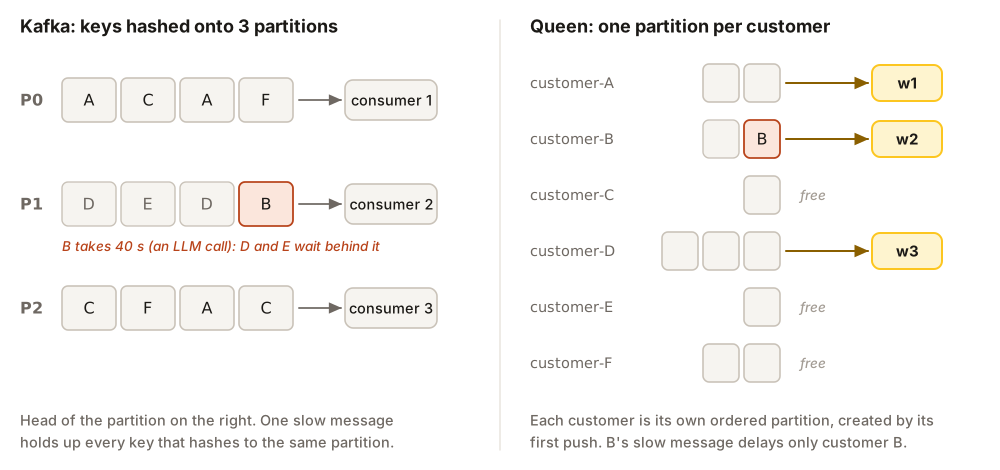
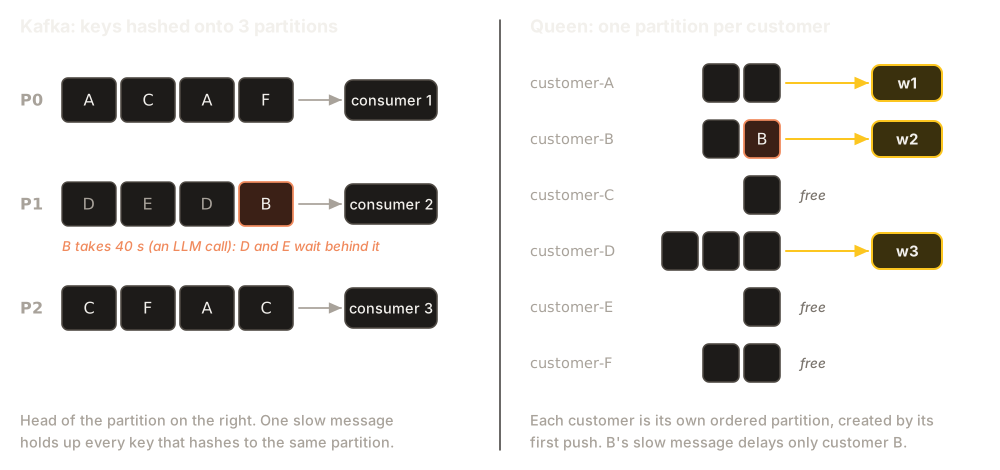
QueenMQ partitions are not physical entities like in Kafka: there is no dedicated thread or file for each partition. A partition is a name, a few rows in the broker’s memory and a position for each consumer group, and its messages live in the log files of its queue.
Leases, not static assignment
A consumer does not own partitions. When it asks for work, the broker gives it a batch from a partition that is free, and leases that partition to it for a while (leaseTime). Until the consumer acks the batch, or the lease runs out, no other consumer of the same group gets that partition. Then the partition is free again, for whoever asks next.
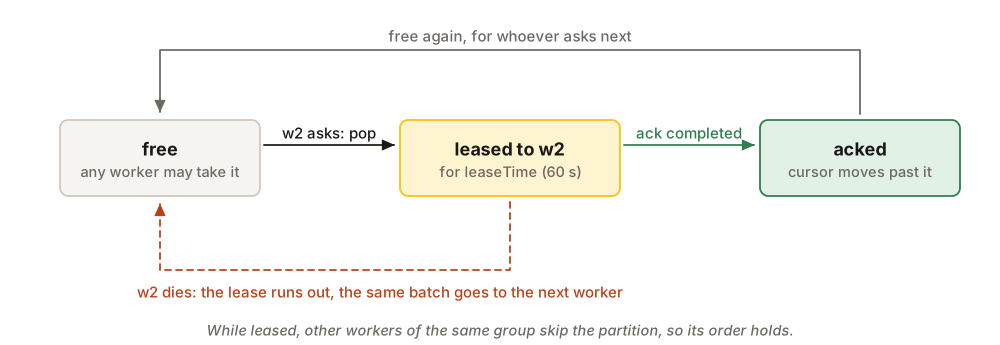
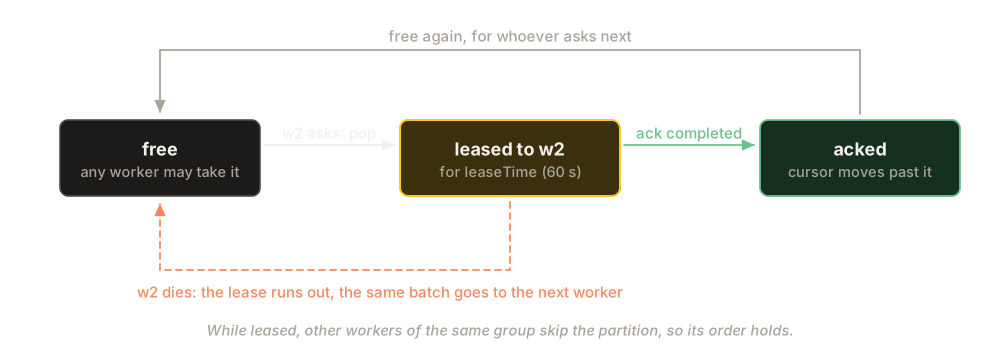
Consumer groups give every reader its own position: each group gets every message, and the workers inside a group share its work. And reading does not delete: an ack only moves the group’s position, and the messages stay until retention removes them, so a new group can read the history again.
Transactions
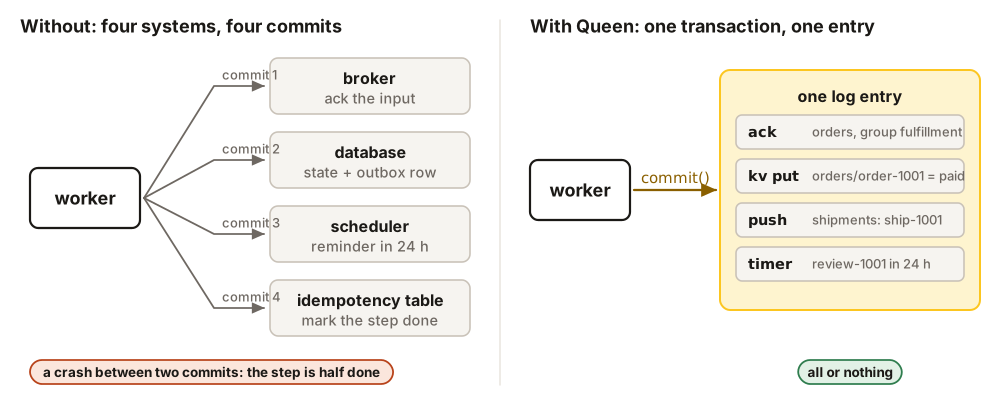
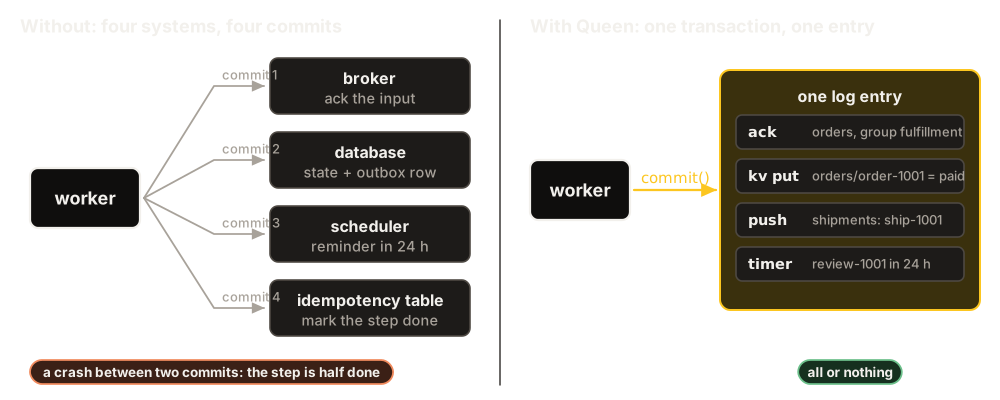
A worker’s step usually does several things: it finishes the message it read, pushes the next events, saves some state, and maybe schedules something for later. In QueenMQ that is one call: a transaction that acks, pushes to any queue, writes to the key-value store and schedules timers, and commits as a single entry of the log, all or nothing.
A simple interface
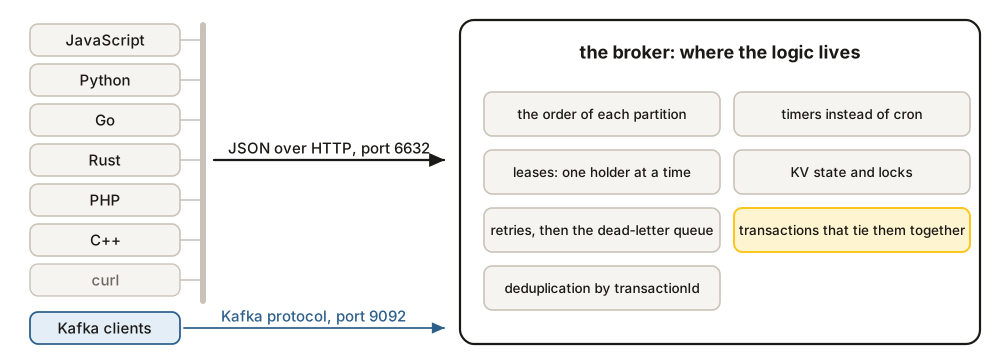
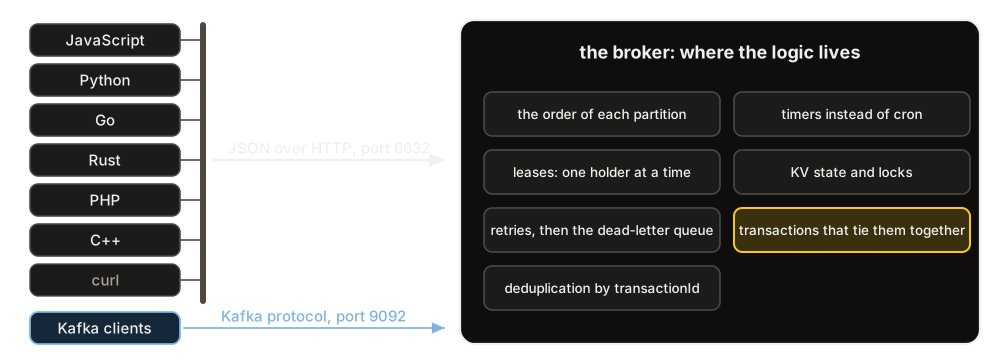
QueenMQ chose a simple API over HTTP: JSON on one port, the same for pushing, consuming, transactions, KV, timers and locks. The SDKs (JavaScript, Python, Go, Rust, PHP, C++) are thin layers over it, curl is enough to try everything, and Kafka clients can talk to the broker through its built-in Kafka port.
Wrap up
In QueenMQ, clients are dumb and the broker is where all the logic lives: the order of each partition, the leases, the retries and the dead-letter queue, deduplication, timers, state, and the transactions that tie them together. Your application keeps only its own business.