An order moves through states: paid, shipping, shipped. A redelivered event, two workers, or an event that arrives late must never move it twice or backwards, and a step must never be half done.
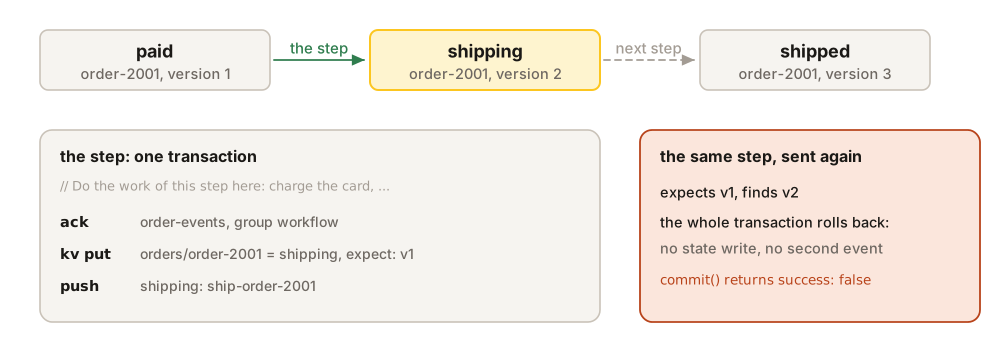
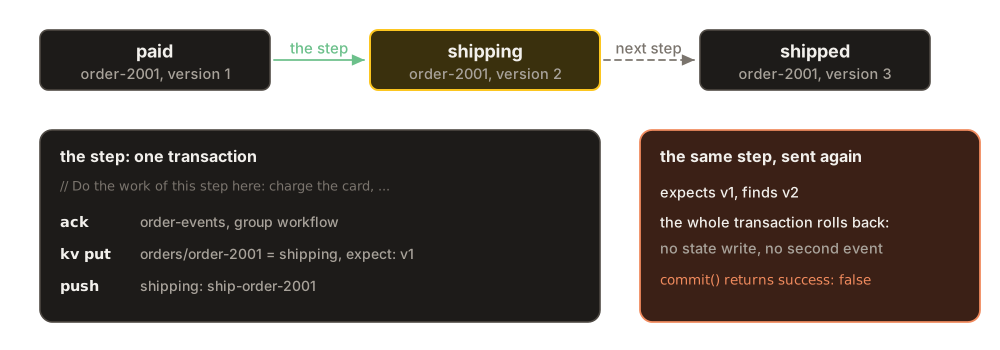
The order’s state lives in KV. Each step is one transaction: it acks the event, writes the new state only if the state is still the version the worker read (expect), and pushes the next event. If the version moved, the whole transaction rolls back, and nothing is written.
await queen.queue('order-events')
  .group('workflow')
  .subscriptionMode('all')
  .autoAck(false)
  .each()
  .consume(async (msg) => {
    const { orderId } = msg.data
    const order = await queen.kv.get('orders', orderId)            // { status: 'paid' }
    if (order.value.status !== 'paid') {                   // already moved: just ack
      return queen.ack(msg, 'completed', { group: 'workflow' })
    }

    // Do the work of this step here: charge the card, book the courier, ...

    const result = await queen.transaction()
      .ack(msg, 'completed', { consumerGroup: 'workflow' })
      .kv.put('orders', orderId, { status: 'shipping' },
        { ttl: '30d', expect: order.version, required: true })  // only from what we read
      .queue('shipping').partition(orderId)
      .push([{ transactionId: `ship-${orderId}`, data: { orderId } }])
      .commit()
    if (result.success === false) return  // moved by someone else: nothing written
  })
async def step(msg):
order_id = msg["data"]["orderId"]
order = await queen.kv.get("orders", order_id) # {'status': 'paid'}
if order["value"]["status"] != "paid": # already moved: just ack
return await queen.ack(msg, "completed", {"group": "workflow"})
# Do the work of this step here: charge the card, book the courier, ...
result = await (
queen.transaction()
.ack(msg, "completed", {"consumer_group": "workflow"})
.kv.put("orders", order_id, {"status": "shipping"},
ttl=timedelta(days=30), expect=order["version"],
required=True) # only from what we read
.queue("shipping").partition(order_id)
.push([{"transactionId": f"ship-{order_id}", "data": {"orderId": order_id}}])
.commit()
)
if not result: # moved by someone else: nothing written
return
await (
queen.queue("order-events")
.group("workflow")
.subscription_mode("all")
.auto_ack(False)
.each()
.consume(step)
)err = client.Queue("order-events").
Group("workflow").
SubscriptionMode(queen.SubscriptionModeAll).
AutoAck(false).
Each().
Consume(ctx, func(ctx context.Context, msg *queen.Message) error {
opts := queen.AckOptions{ConsumerGroup: "workflow"}
orderID := msg.Data["orderId"].(string)
order, err := client.KV().Get(ctx, "orders", orderID) // Value {"status":"paid"}
if err != nil {
return err
}
var state struct{ Status string }
if err := json.Unmarshal(order.Value, &state); err != nil {
return err
}
if state.Status != "paid" { // already moved: just ack
_, err := client.Ack(ctx, msg, true, opts)
return err
}
// Do the work of this step here: charge the card, book the courier, ...
next := map[string]interface{}{"status": "shipping"}
result, err := client.Transaction().
Ack(msg, queen.AckStatusCompleted, opts).
KV(queen.KVPutOp("orders", orderID, next, queen.TTL(30*24*time.Hour),
queen.KVWriteOptions{
Expect: queen.Expect(order.Version), // only from what we read
Required: true,
})).
Queue("shipping").Partition(orderID).
Push(queen.PushItem{TransactionID: "ship-" + orderID,
Payload: map[string]interface{}{"orderId": orderID}}).
Commit(ctx)
if err != nil {
return err
}
if result.IsKVPrecondition() {
fmt.Println(orderID, "moved by someone else: nothing written")
}
return nil
}).
Execute(ctx)
if err != nil {
log.Fatal(err)
}let client = queen.clone();
queen
.queue("order-events")
.group("workflow")
.subscription_mode(SubscriptionMode::All)
.auto_ack(false)
.consume(move |msg: Message| {
let queen = client.clone();
async move {
let order_id = msg.data["orderId"].as_str().unwrap_or_default().to_string();
let order = queen.kv().get("orders", &order_id).await?; // {"status":"paid"}
if order.value.as_ref().and_then(|v| v["status"].as_str()) != Some("paid") {
queen.ack(&msg).await?; // already moved: just ack
return Ok(());
}
// Do the work of this step here: charge the card, book the courier, ...
let thirty_days = Expiry::seconds(30 * 86400);
let shipping = queen
.kv()
.put("orders", &order_id, json!({ "status": "shipping" }), thirty_days)
.expect(order.version.unwrap_or(0)) // only from what we read
.required()
.operation()?;
let result = queen
.transaction()
.ack(&msg)
.kv(shipping)
.push_item(TxnPushItem {
queue: "shipping".into(),
partition: Some(order_id.clone()),
payload: json!({ "orderId": order_id }),
transaction_id: Some(format!("ship-{order_id}")),
trace_id: None,
})?
.commit()
.await?;
if !result.success {
return Ok(()); // moved by someone else: nothing written
}
Ok::<_, queen_mq::Error>(())
}
})
.await?;$queen->queue('order-events')
->group('workflow')
->subscriptionMode('all')
->autoAck(false)
->each()
->consume(function (array $msg) use ($queen) {
$orderId = $msg['data']['orderId'];
$order = $queen->kv()->get('orders', $orderId); // value: [status => paid]
if ($order['value']['status'] !== 'paid') { // already moved: just ack
$queen->ack($msg, 'completed', ['group' => 'workflow']);
return;
}
// Do the work of this step here: charge the card, book the courier, ...
$result = $queen->transaction()
->ack($msg, 'completed', ['consumerGroup' => 'workflow'])
->kv('orders')->put($orderId, ['status' => 'shipping'], [
'ttlSeconds' => 30 * 86400,
'expect' => $order['version'], // only from what we read
'required' => true,
])
->queue('shipping')->partition($orderId)->push([
['transactionId' => "ship-{$orderId}", 'data' => ['orderId' => $orderId]],
])
->commit();
if ($result['success'] === false) {
return; // moved by someone else: nothing written
}
})
->execute();client.queue("order-events")
.group("workflow")
.subscription_mode("all")
.auto_ack(false)
.each()
.consume([&](const json& msg) {
const std::string order_id = msg["data"]["orderId"];
json order = client.kv("orders").get(order_id); // value: {"status":"paid"}
if (order["value"]["status"] != "paid") { // already moved: just ack
client.ack(msg, true, {{"group", "workflow"}});
return;
}
// Do the work of this step here: charge the card, book the courier, ...
queen::KvWriteOptions from_what_we_read; // only from what we read
from_what_we_read.expect = order["version"].get<long long>();
from_what_we_read.required = true;
// client.transaction() cannot give its push a partition, so the step goes
// to the broker's transaction route through the client's own HTTP layer.
json step = {
{"operations", json::array({
{{"type", "ack"}, {"status", "completed"},
{"consumerGroup", "workflow"}, {"leaseId", msg["leaseId"]},
{"transactionId", msg["transactionId"]},
{"partitionId", msg["partitionId"]}},
{{"type", "push"}, {"items", json::array({{
{"queue", "shipping"}, {"partition", order_id},
{"transactionId", "ship-" + order_id},
{"payload", {{"orderId", order_id}}},
}})}},
})},
{"requiredLeases", json::array({msg["leaseId"]})},
{"kv", json::array({queen::wire::kv_write_op("put", "orders", order_id,
{{"status", "shipping"}}, queen::KvTtl::seconds(30 * 86400),
from_what_we_read)})},
};
json result = client.get_http_client()->post("/api/v1/transaction", step);
bool committed = result.value("success", false);
if (!committed) return; // moved by someone else: nothing written
});The step moved order-2001 to shipping and pushed one shipping event. The same step sent again from the old version rolled back: still one event.
One thing to know: a rollback is an answer, not an error. commit() returns success: false (in Go, IsKVPrecondition() on the result) and does not throw. Read it.
Built from: Transactions, KV, locks and timers.