A message is written once, in its queue’s log files, and that write is what makes it durable: there is no second copy. We built it this way on purpose. An earlier design wrote every message twice, first in a consensus log and then in a segment file. Now the bytes that make a message durable are the bytes a pop reads back.
The data directory
Everything a node knows is in one directory:
/var/lib/queen/raft
  qlog/                    the messages: one log per queue
    LANES                  the log layout, fixed at creation (and SHARDS, when set)
    q0/                    the system log: entries that touch no queue
    q5837314263283300749/  one directory per queue
      r00000001.qlog       a log file, up to 64 MiB, then the next one starts
      r00000001.qidx       the index of a closed file
      r00000001.qhsh       the dedup hashes of a closed file, for a fast restart
  store/data.mdb           the state checkpoint (LMDB)
  traces/data.mdb          message traces (LMDB)
  raft/                    cluster only: vote, members, what is kept for an away node
  snapshots/               a snapshot from the leader, waiting for the next start
  seg/  log/               almost empty, from an earlier design
  local.db  dash.db        this node's own metrics and dashboard data
  groups/g1/               the same tree for each extra raft group
A closed file never changes again. Payloads of 512 bytes or more are compressed with zstd, when it saves at least a tenth. With thousands of queues, QUEEN_QLOG_SHARDS puts them all into a few shared logs, so a write syncs a few files instead of thousands.
What is inside a log file
A log file is a 32-byte header and then records, one after the other. Here is the start of a real file, after one push of order-8891 with data {"orderId":8891}:
xxd qlog/q5837314263283300749/r00000001.qlog | head -10
00000000: 514e 514c 4f47 3100 0100 0000 0000 0000  QNQLOG1.........
00000010: 0b00 0000 0000 0000 0000 0000 0000 0000  ................
00000020: 6e00 0000 da25 b6dc 1ed0 878c 0b00 0000  n....%..........
00000030: 0000 0000 0100 0000 0000 0000 0000 0000  ................
00000040: 0000 0000 0100 0000 75e7 b953 935e 0600  ........u..S.^..
00000050: 00b9 7eb7 7dcc 2db6 dcbc ff49 4354 80b3  ..~.}.-....ICT..
00000060: c82d 0000 0000 01a1 6d65 4e4f 7001 bf27  .-......meNOp..'
00000070: b56a 9334 d445 0a00 6f72 6465 722d 3838  .j.4.E..order-88
00000080: 3931 7b22 6f72 6465 7249 6422 3a38 3839  91{"orderId":889
00000090: 317d da01 0000 6b08 25f1 17ae 81e2 0b00  1}....k.%.......
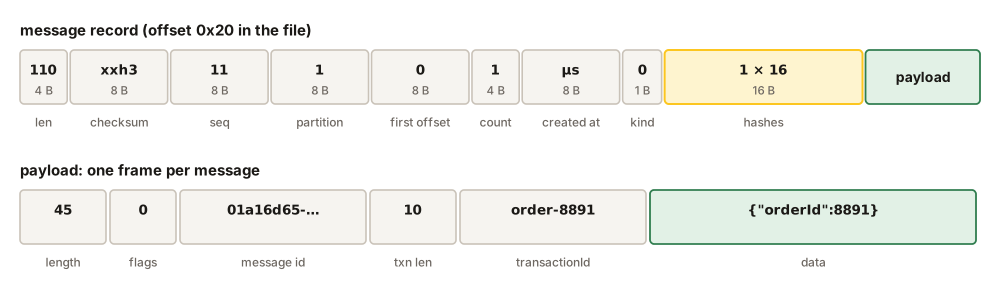
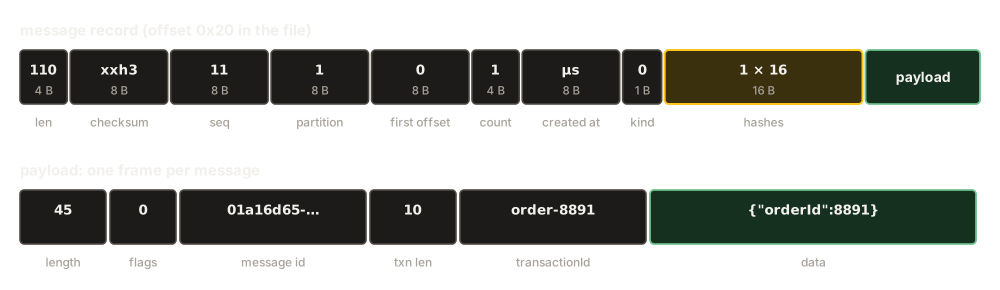
The record starts at byte 0x20. Every number is little-endian.
| Field | Bytes | In this record |
|---|---|---|
len |
4 | 110: the bytes after this field. A reader always knows where the next record starts. |
checksum |
8 | An xxh3 of everything after it. A record torn by a crash fails it, and is cut. |
seq |
8 | 11: the log entry that wrote this record. |
partition |
8 | 1: the partition id. |
first offset |
8 | 0. |
count |
4 | 1 message. |
created at |
8 | The time of the push, in microseconds. |
kind |
1 | 0: messages. The top bit says the payload is compressed. |
hashes |
16 a message | The hash of order-8891, for dedup. |
payload |
the rest | One frame per message: its length (45), flags, its 16-byte id, its transactionId and its data. |
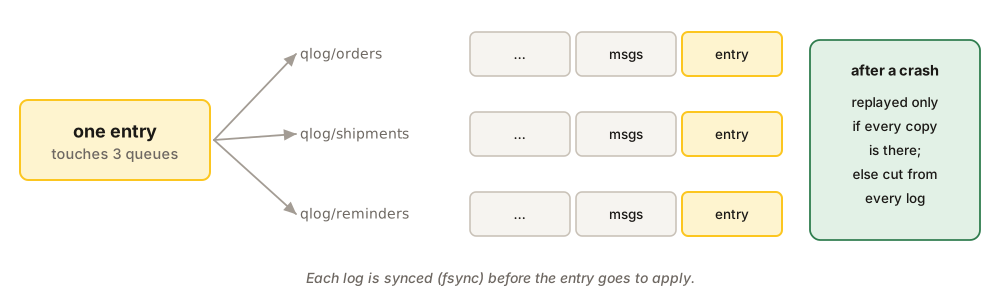
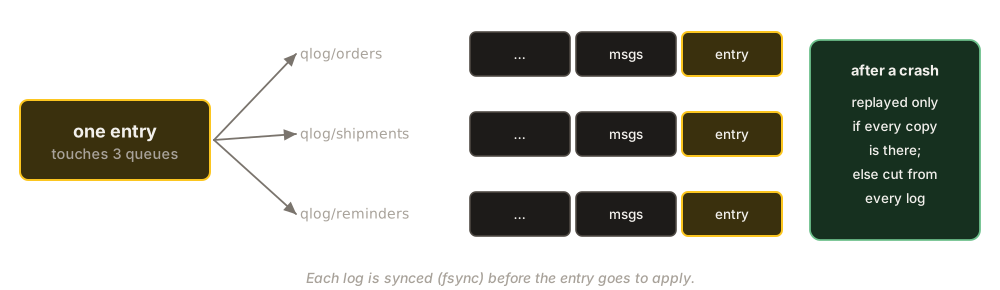
The next record (474 bytes, at 0x92) has the same seq, 11: it is the log entry itself, without the payload. An entry that touches several queues is written into each of their logs, and after a crash it is replayed only if every copy is there. This is how a transaction stays all or nothing on disk.
How retention works
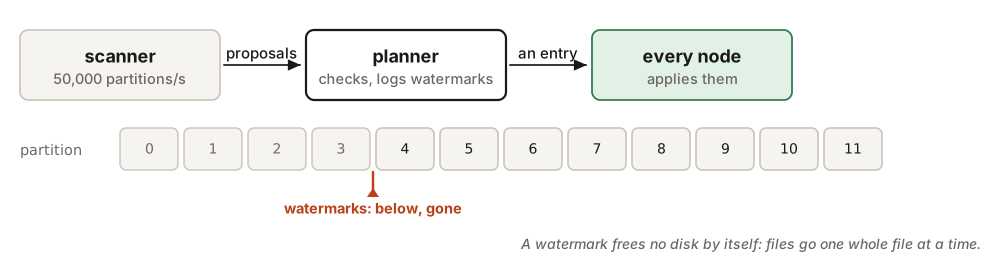
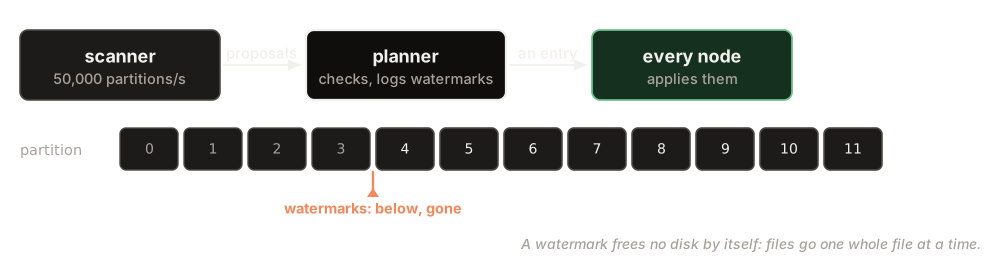
Retention is decided once, on the leader, like every write. A scanner walks all the partitions (50,000 a second) and proposes what can go. The planner checks each proposal and logs watermarks: below one the messages are gone, below another their dedup records are gone. A partition that is empty, with no dead letter, no lease and no write for the cleanup age, is deleted.
Moving a watermark frees no disk by itself. Each node then frees its own files, one whole file at a time.
Rewriting a file
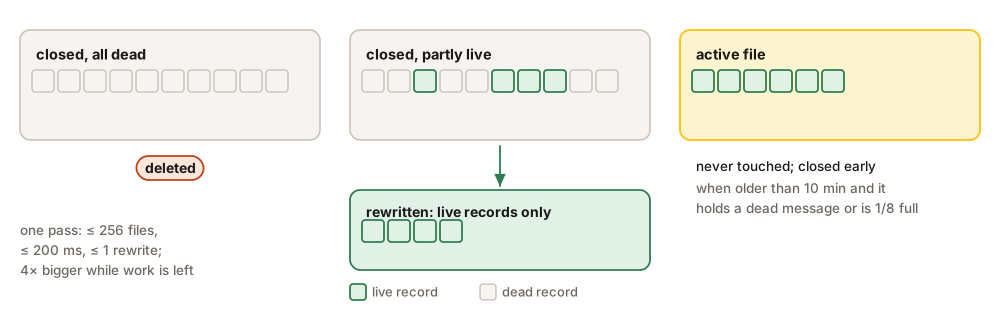
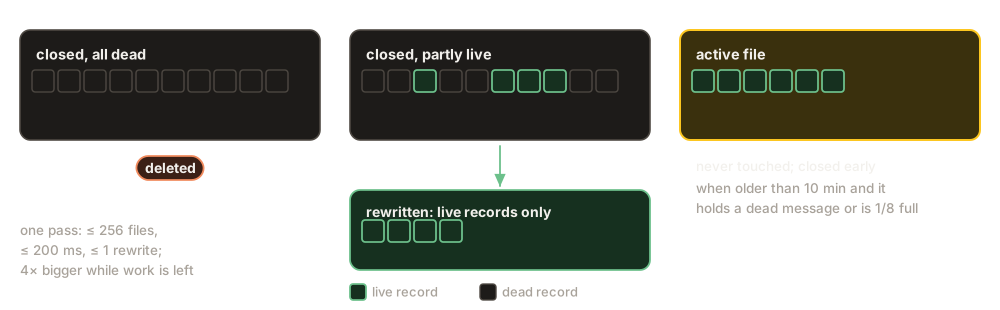
A closed file with no live record is deleted. A closed file that is partly live is rewritten: the node copies only the live records into a new file, without stopping the writes, and swaps it in. A queue’s own file is rewritten at its first dead message, a shared file when half of it is dead.
The active file is never touched, and neither is a file that recovery or a node that is behind still needs. One pass looks at up to 256 files, for at most 200 ms, and rewrites at most one file; while work is left, the next pass is four times bigger. An active file with data older than 10 minutes is closed early, so retention can reach it, when it holds a dead message or is an eighth full.