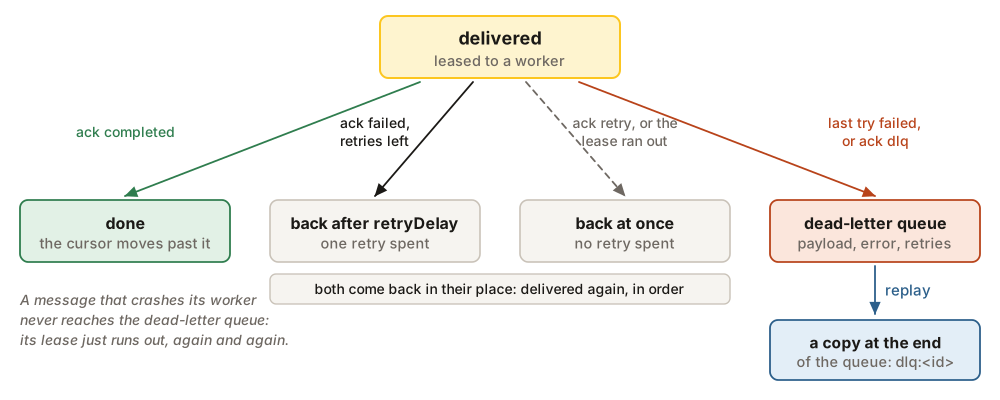
Every failed ack spends one retry. The message comes back after the queue’s retryDelay, and its partition waits with it, for that consumer group. After retryLimit failures, the message goes to the dead-letter queue and the group moves on. You set both on the queue (see Create and configure queues).
Two cases do not spend a retry: a retry ack, and a lease that runs out. So a message that crashes its worker’s process every time comes back forever and never reaches the dead-letter queue. If some input can crash your worker, check for it before the work starts and ack such a message with dlq.
What a dead letter keeps
A dead letter keeps the payload, the error the worker sent, the number of retries, and the consumer group that gave up on it. It stays until you replay it or delete it. Each group has its own: a message that failed for billing can be fine for analytics.
Some SDKs lose the error text on the way in 2.6.0: a Go or C++ transaction ack with dlq, and the automatic nack of PHP’s consume loop, file the message as “Retries exhausted”. Ack with failed or dlq and an error outside a transaction when the reason matters.
Read it
const dead = await queen.queue('payments').dlq('charger').limit(20).get()
for (const letter of dead.messages) {
  console.log(letter.transactionId, letter.errorMessage, letter.retryCount)
}
dead = await queen.queue("payments").dlq("charger").limit(20).get()
for letter in dead["messages"]:
print(letter["transactionId"], letter["errorMessage"], letter["retryCount"])dead, err := client.Queue("payments").DLQ("charger").Limit(20).Get(ctx)
if err != nil {
log.Fatal(err)
}
for _, letter := range dead.Messages {
fmt.Println(letter.TransactionID, letter.ErrorMessage, letter.RetryCount)
}let dead = queen.queue("payments").group("charger").dlq(Some(20), None).await?;
for letter in &dead.messages {
let id = letter.transaction_id.as_deref().unwrap_or_default();
let error = letter.error.as_deref().unwrap_or_default();
// retryCount has no field of its own in the Rust client: it is in `rest`
let retries = letter.rest.get("retryCount").cloned().unwrap_or_default();
println!("{id} {error} {retries}");
}$dead = $queen->queue('payments')->dlq('charger')->limit(20)->get();
foreach ($dead['messages'] as $letter) {
echo $letter['transactionId'], ' ', $letter['errorMessage'], ' ',
$letter['retryCount'], "\n";
}json dead = client.queue("payments").dlq("charger").limit(20).get();
for (const json& letter : dead["messages"]) {
std::cout << letter["transactionId"] << " " << letter["errorMessage"] << " "
<< letter["retryCount"] << "\n";
}limit() and offset() page through it, newest first. The JavaScript client also has from() and to(), but the 2.6.0 broker ignores them.
Replay it
Once the cause is fixed, put the messages back:
for (const letter of dead.messages) {
  // back into its partition, and out of the dead-letter queue
  await queen.admin.retryMessage(letter.partitionId, letter.transactionId)
}
for letter in dead["messages"]:
# back into its partition, and out of the dead-letter queue
await queen.admin.retry_message(letter["partitionId"], letter["transactionId"])for _, letter := range dead.Messages {
// back into its partition, and out of the dead-letter queue
_, err := client.Admin().RetryMessage(ctx, letter.PartitionID, letter.TransactionID)
if err != nil {
log.Fatal(err)
}
}for letter in &dead.messages {
// back into its partition, and out of the dead-letter queue
if let (Some(partition_id), Some(transaction_id)) =
(&letter.partition_id, &letter.transaction_id)
{
queen.admin().retry_message(partition_id, transaction_id).await?;
}
}foreach ($dead['messages'] as $letter) {
// back into its partition, and out of the dead-letter queue
$queen->admin()->retryMessage($letter['partitionId'], $letter['transactionId']);
}for (const json& letter : dead["messages"]) {
// back into its partition, and out of the dead-letter queue: the broker's
// replay route, through the client's own HTTP layer (no call for it in C++)
const std::string id = letter["id"];
client.get_http_client()->post("/api/v1/dlq/" + id + "/replay");
}A replay moves the dead letter back into its partition, at the end, as a new message with the transactionId dlq:<id>, and removes it from the dead-letter queue in the same step. Doing it twice cannot create a second copy. Every group that reads that partition sees the replayed message, not only the group that gave up on it. Over HTTP the same thing is POST /api/v1/dlq/:id/replay.
Skip it, or turn it off
An ack with dlq files a message straight away, without spending its retries. Setting deadLetterQueue and dlqAfterMaxRetries to false on the queue drops a message that runs out of retries instead of keeping it.
See also
- Acknowledge: the four answers, and which of them spend a retry.
- Retries and dead letters: a webhook sender built on them.
- HTTP API: the dead-letter endpoints.