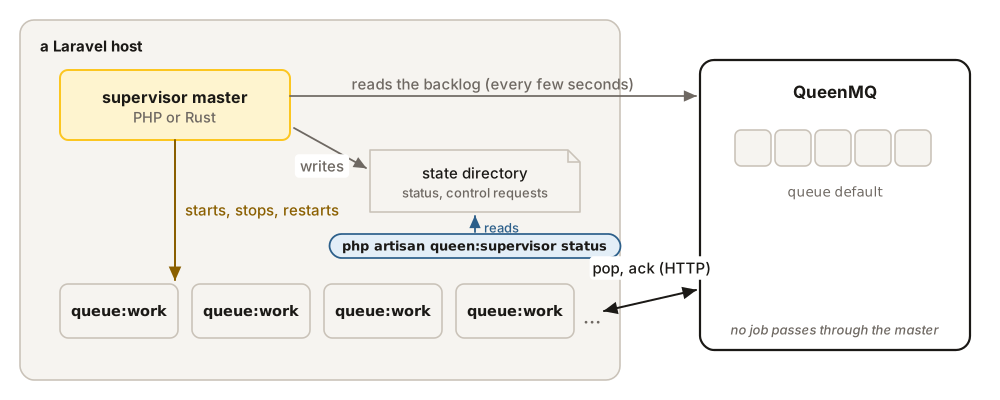
The supervisor is the part of Horizon that starts queue:work processes, keeps the right number
on each queue and stops them cleanly at a deploy. Queen has two: a PHP engine that runs straight
from the Composer package, and a Rust engine whose master stayed at 7.0 MiB of resident memory
through a 45-minute soak while Horizon’s held 49.1 MiB
(benchmark); with prefork, a fork server beside it holds the
booted Laravel. Both read the same config/queen.php, publish the
same status and obey the same commands, so you can start on one and move to the other without
touching a pool.
php artisan queen:supervise                               # the PHP engine

php artisan queen:supervisor-install                      # the Rust engine, installed explicitly
vendor/bin/queen-supervisor --php php --artisan artisan
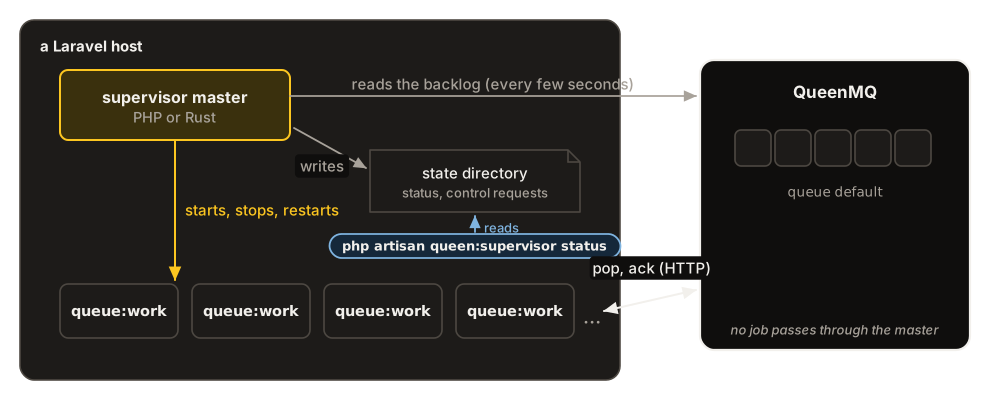
The workers are ordinary php artisan queue:work queen processes in both cases. The broker never
starts PHP: the supervisor is a local process on each worker host, and the broker only answers it.
| Engine | Master process | Use it when |
|---|---|---|
| PHP | Laravel stays loaded in one PHP master | there is no native build for the host, or as the reference during a Rust rollout |
| Rust | Rust, after one temporary Artisan run that resolves the configuration | you want the smallest master; on Linux it also gives every worker a parent-death signal |
Requirements
- PHP 8.3 or newer, on Unix. Native Windows is not supported by either engine.
- The
pcntlandposixextensions, for process control, the ownership checks of the state directory and the Composer launcher;symfony/processfor the PHP engine. pharand a workingproc_open, to install and smoke-test the native binary.- An outer process monitor (systemd, Kubernetes, Supervisor) that restarts the master if it exits.
Thread-safe PHP, such as the build FrankenPHP embeds, works too. There chdir() does not move the
process, so the launcher runs the verified binary by its absolute path: every check still runs,
but the exec is not pinned to the verified inode as it is on ordinary PHP.
The queue connection on its own needs none of this. If another process manager runs a fixed number of workers, you can skip this page.
Prepare a private state directory
Status, the ownership lock, control requests, worker telemetry and the workers’ exit markers share one directory. Create it as the user that runs the supervisor:
install -d -m 0700 /srv/example/queen-supervisor-stateQUEEN_SUPERVISOR_STATE_DIRECTORY=/srv/example/queen-supervisor-stateThe supervisor refuses to start on a directory that another user could write to, so do not loosen
it to fit a Laravel storage/ directory with mode 0775. It checks ownership, modes, symlinks and
replacement of the path, and fails closed. Keep it outside the web root. The native binary has
an installation directory of its own, with a different policy, described below.
Configure a pool
Publish config/queen.php and edit supervisor.supervisors. Each entry is a pool, like a Horizon
supervisor: a set of workers with one configuration (every key is in the
configuration reference). This one gives a pool a budget of
20 workers across two queues:
'supervisor' => [
    'poll_interval' => 3,
    'shutdown_grace' => 75,
    'process_limit' => 20,
    'state_directory' => env('QUEEN_SUPERVISOR_STATE_DIRECTORY', storage_path('queen-supervisor')),
    'supervisors' => [
        'jobs' => [
            'connection' => 'queen',
            'consumer_group' => 'laravel',
            'queues' => ['high', 'default'],
            'balance' => 'auto',
            'strategy' => 'time',
            'min_processes' => 2,
            'max_processes' => 20,
            'min_processes_per_queue' => 1,   // every queue keeps a warm worker
            'fast_scale_up' => true,          // close half the gap per cycle
            'target_clear_seconds' => 60,
            'default_runtime_seconds' => 1,
            'balance_cooldown' => 3,
            'balance_max_shift' => 2,
            'scale_down_delay' => 10,
            'timeout' => 60,
            'retry_after' => 90,
            'tries' => 3,
            'memory' => 128,
        ],
    ],
],
Two fixed workers for slow jobs
For a queue that calls external services, two workers keep execution capacity available while
one waits for a response. Put these settings in the published config/queen.php:
'prefetch' => 1,
'ack_batch' => 1,
'pop_ahead' => false,
'lease_renewal' => false,
'supervisor' => [
    'process_limit' => 2,
    'supervisors' => [
        'default' => [
            'connection' => 'queen',
            'consumer_group' => 'laravel',
            'queues' => ['default'],
            'balance' => 'simple',
            'processes' => 2,
            'min_processes' => 2,
            'max_processes' => 2,
            'timeout' => 60,
            'retry_after' => 90,
            'tries' => 3,
        ],
    ],
],
simple keeps this fixed target even with an empty queue. Keep processes, min_processes
and max_processes aligned for a fixed pool: processes is clamped to the min/max bounds.
The master starts ordinary PHP workers; it does not execute the jobs itself. Each worker
claims one job at a time here, so a busy worker holds no prefetched tail. Spare workers can
advance on other partitions; jobs in the same partition
still wait in order.
The process budget must cover every pool’s maximum and its renewal reservation:
| Two-worker pool | Minimum process_limit |
Why |
|---|---|---|
lease_renewal=false, prefetch=1, pop_ahead=false |
2 | One child slot per worker |
lease_renewal=true, including when prefetch is above 1 |
4 | One worker slot and one renewal-helper slot per worker |
The four-slot budget remains required when the Rust master renews leases on Linux. The helper
slot is reserved for fallback; it does not mean four PHP processes normally run. Without renewal,
keep the worker timeout and every job’s timeout below retry_after. Turning on renewal keeps
leases safe during a long wait; the prefetch tradeoff
still applies.
Master settings and startup checks
The keys outside supervisors apply to the whole master. Two of them read an environment variable,
named in parentheses; set the others in the file:
| Key | Default | Meaning |
|---|---|---|
poll_interval |
3 s | how often the master reads the backlog and reconciles its pools |
http_timeout |
5 s | the timeout of each broker request the master sends, per endpoint |
control_ttl |
3,600 s | how long a pause, continue or terminate request stays valid, 30 to 86,400 s |
heartbeat_timeout |
one second above one bounded pass of the control loop, at least 15 s | how old the master’s heartbeat can be before status calls it dead |
shutdown_grace |
75 s | how long workers drain at a stop before the master kills them |
process_limit |
256 | the most supervised child processes, at most 4,096 |
state_directory (QUEEN_SUPERVISOR_STATE_DIRECTORY) |
storage/queen-supervisor |
the private state directory |
telemetry_ttl |
300 s | how long a worker’s runtime report counts for the time strategy |
read_bearer_token (QUEEN_SUPERVISOR_READ_BEARER_TOKEN) |
the connection’s token | the token for depth reads and the event-driven long poll |
The supervisor checks the inequalities that keep a job safe before it starts a single worker, so a mistake shows up at the deploy instead of as a job that runs twice:
retry_afteris longer than the pool’stimeout, andshutdown_graceis longer than every pool’stimeout.- In
automode,max_processescovers every queue of the pool. - The pools’ maxima fit
process_limit. A worker with lease renewal reserves two child slots, one for Artisan and one for its renewal helper, even when the master renews the leases, because a worker the master refuses starts a helper. - The control TTL and the heartbeat timeout exceed one bounded pass of the control loop. With remote status on, that pass includes one request timeout per broker endpoint for the publish, and the publish interval stays below the heartbeat timeout; with coordination on, one request timeout per broker endpoint for every four autoscaling pools.
To see exactly what either engine will run:
php artisan queen:supervisor-config --prettyThat form redacts tokens and header values. --for-engine is the form the Rust engine loads, with
its credentials included (the write credential too, because that engine also publishes status and
coordinates replicas), so never send it to a log or a build artifact.
Both engines print configuration warnings when they start, such as a pool with tries 1 on a
connection with prefetch above 1 or pop_ahead. queen:supervise prints them on its output.
queen:supervisor-config prints them on standard error, as Queen warning: … lines, and the Rust
master passes that standard error to its own log while it reads the document from standard output.
How a pool scales
balance |
Workers | Use it for |
|---|---|---|
auto |
the total follows the backlog, and workers go to the queues under pressure | elastic queues with no strict priority |
simple |
processes, fixed and spread evenly |
predictable capacity |
off |
every worker gets the whole ordered queue list | strict Laravel priority, such as high,default |
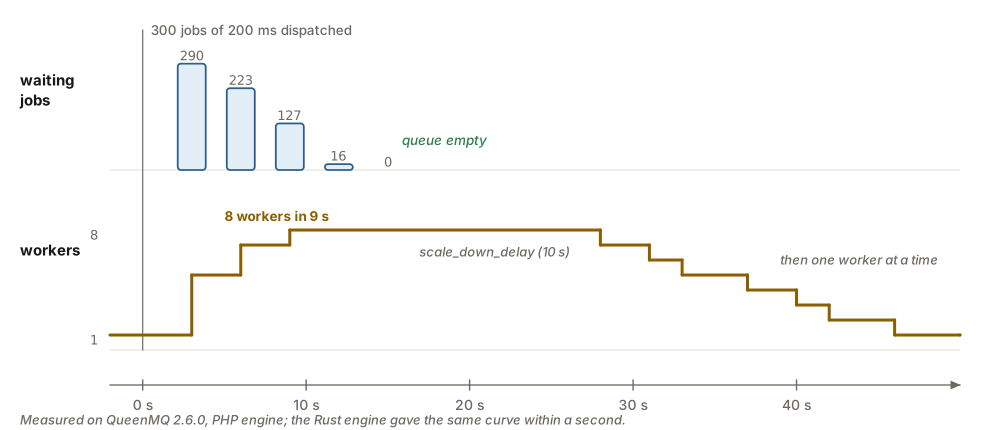
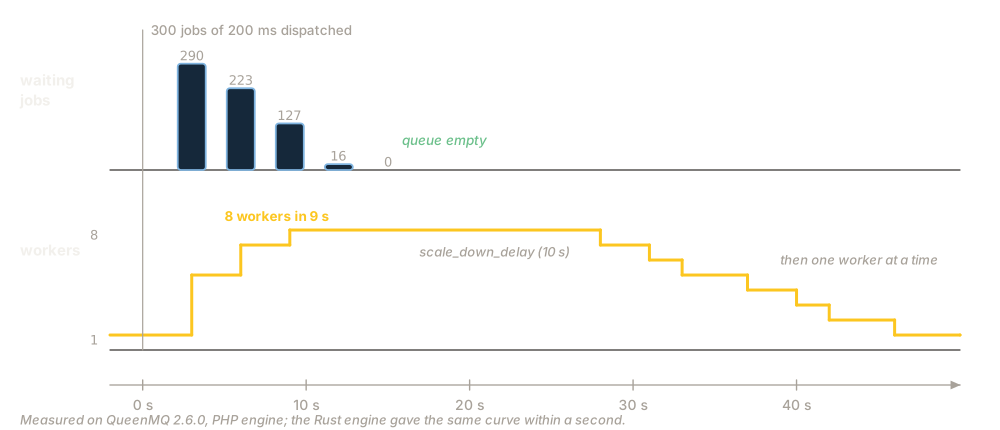
We measured that run on 2.6.0 with balance auto, target_jobs_per_process 10 and fast_scale_up: five workers three seconds after the dispatch, eight at nine seconds, the queue empty at fifteen, and the extra workers given back one at a time after scale_down_delay. The Rust engine gave the same curve within a second.
In auto mode the master reads the backlog of each queue every poll_interval and sizes the pool
between min_processes and max_processes. The backlog is the consumer group’s
effectivePending from the broker’s depth read: every job not yet acknowledged, running ones
included, and no delayed job until its timer fires. The size strategy aims at one worker per
target_jobs_per_process jobs of that backlog. The time strategy multiplies the backlog by the
job runtime the workers report and aims to clear it within target_clear_seconds, using
default_runtime_seconds until the first reports arrive. A pool changes by at most
balance_max_shift workers per balance_cooldown, and a lower target has to hold for
scale_down_delay before workers drain. A draining worker still counts against process_limit,
helper included, so a reallocation never makes a burst of processes. Both engines send a pool’s
depth reads in waves of at most 16 concurrent requests.
Every entry in supervisors is its own pool, so one application can mix workers dedicated to a
queue with workers that move between queues, as Horizon supervisors do:
'supervisors' => [
    'payments' => ['queues' => ['payments'], 'balance' => 'simple', 'processes' => 2],
    'shared'   => ['queues' => ['emails', 'default', 'reports'], 'balance' => 'auto',
                   'min_processes' => 1, 'max_processes' => 20, 'min_processes_per_queue' => 1],
],
min_processes bounds a whole pool. min_processes_per_queue, Horizon’s per-queue
minProcesses, keeps that many workers on every queue of an auto pool even with no backlog, so
the first job on a quiet queue finds a worker already running. The floor for every queue has to fit
max_processes.
By default each cycle adds at most balance_max_shift workers, one unless you raise it, as in
Horizon: a burst that needs twenty workers takes nineteen cycles. With fast_scale_up, each cycle
closes half of the remaining gap, and the same burst takes five. Scaling down keeps its step and
its scale_down_delay.
Event-driven scaling
A pool that polls reacts at the pace of its cycle: three seconds to notice a burst, and three more
for every step. With event_driven, the broker wakes the supervisor when jobs arrive:
// config/queen.php
'supervisor' => [
    'event_driven' => true,
    // ...
],
The supervisor holds a read-only long poll, POST /api/v1/fetch, over the stripes of every pool
that follows the backlog, <partition_prefix>-0000 up to <partition_prefix>-<partitions - 1>.
Every 2.0 broker serves it. A fetch reads a partition by offset: it takes no lease and moves no
cursor, so it never takes a job from a worker, and the broker answers it as soon as one of the
watched partitions grows. One fetch watches at most 1,024 stripes per connection, counting every
queue of every pool on that connection: with more, the supervisor logs it at start, watches the
first 1,024, and the regular poll finds jobs on the others.
When a watched partition grows, the pool reads its depth and adds workers at once, inside
balance_cooldown too, and keeps growing every second while it is below its target. No queue
loses a worker in such an early step, and scaling down keeps its cooldown and scale_down_delay.
A pool is woken at most once a second and not at all at max_processes, so a busy queue costs at
most one fetch and one depth read per second. A job pushed to a partition of its own
(QueenPartitionable) is found by the regular poll, as before, and a queue that does not exist
yet is probed again every 30 seconds. The answer carries the first new job of each grown stripe,
payload included, which the supervisor reads and throws away; an answer over 8 MiB is not read at
all and wakes every watched queue. The Rust engine parks in a thread for up to 20 seconds at a
time, the PHP engine for up to one second inside its loop.
On the Linux server, with event_driven and fast_scale_up, a pool of 1 to 64 workers reached 64
workers 8.2 s after a burst of 30,000 jobs began, and finished the jobs, dispatch included, after
9.5 s. Horizon took 37.0 s, and its dispatch was too slow for it to need more than about 34
workers (benchmark).
The long poll uses the token the supervisor reads depth with: read_bearer_token when you set one, the connection’s token
otherwise. On the broker’s own JWT the fetch is a read, so a read-only token passes; through the
embedded proxy it carries the authority of a pop, so there the token must be
allowed to consume. When the broker refuses the long poll, the supervisor logs it once and keeps
polling. Event-driven scaling needs PHP client 1.8.0 (supervisor 0.5.0).
Run the PHP engine
php artisan queen:superviseIt runs from the Composer package, with no native binary. A worker that exits non-zero shortly
after it started is restarted after a capped exponential backoff; after five failures in a row the
pool’s circuit opens, and after restart_backoff_max it lets one probe worker through until that
worker has run for stable_after. The Rust engine does the same.
Since PHP client 1.9.0, three exits restart at once in both engines, without backoff: a worker that
ran for stable_after, one that Laravel killed after a job timeout, and one that stopped at
--memory after handling a job. The last two leave a marker in the state directory before they
exit, which is how the master tells them from a crash. Every other non-zero exit counts as a
failure, including a SIGKILL without that marker, such as the OOM killer’s. Before 1.9.0 a burst of
job timeouts could open the circuit and hold a healthy pool at one worker.
Since PHP client 2.4.4 and supervisor 0.8.2, those three exits and a worker that stopped for
queue:restart are also replaced outside balance_max_shift and whatever the circuit says, up to
the size the pool had: a pool that loses most of its workers at once, as at a deploy, is refilled in
one cycle, and a worker that stops at --max-time while a probe runs is replaced at once. Any other
exit, even with status 0, waits for the budget and the circuit as before: Laravel’s worker exits 0
when it loses its database connection, every second through an outage.
Laravel’s worker catches what a pop throws, reports it, sleeps a second and pops again, so a worker
whose every pop fails stays alive and looks like capacity. Since PHP client 2.4.2 a worker started
by either engine tells the two cases apart. When its loop works another connection than its pool’s,
or a pop throws a LogicException (an InvalidArgumentException included), no retry can help: the
worker throws WorkerCannotConsume from its next loop, which reaches the application’s exception
handler, and exits 1, a crash like any other. A job whose own $timeout its lease cannot cover
no longer stops the worker since PHP client 2.4.4: that job fails alone, as a migration
note explains. When the broker is down, slow or refusing, a
restart cannot help either, and restarting every worker would turn a short outage into a restart
storm: the worker stays, and leaves a small file in the state directory saying since when its pops
fail. A pop that works, empty or not, clears the failure of its own queue, and the file goes once
no queue fails, so a worker of --queue=high,low whose every pop of low fails is reported even
while high answers (PHP client 2.4.4). A pop that failed because the broker reset the connection
no longer makes Laravel stop the worker as if it had lost its database (2.4.4).
queen:supervisor status reads the file; see below.
Run the Rust engine
The Composer package carries a launcher; the binary for your platform is installed in a separate, explicit step, so Composer never downloads and runs native code on its own:
install -d -m 0755 /srv/example/queen-supervisor-bin
export QUEEN_SUPERVISOR_INSTALL_PATH=/srv/example/queen-supervisor-bin
php artisan queen:supervisor-install
vendor/bin/queen-supervisor --php php --artisan artisan
The launcher reads QUEEN_SUPERVISOR_INSTALL_PATH from its own environment, not from .env, so
the service that starts it needs the variable too.
The installer picks the version the package pins and the host’s target, verifies the release
manifest, the archive’s SHA-256, the executable’s version and a local receipt, then publishes the
binary by atomic rename. The launcher checks the receipt and the binary’s hash again before every
start and then replaces itself with the binary, so the Rust master is the process your service
manager signals. The installation leaf’s parent has to be a real directory (a symlink is refused),
and an existing leaf must not be group- or world-writable, which is why it lives apart from
Laravel’s storage/.
The user that runs the launcher must also own the installation, each of its directories and files,
so install as that user. If root installs and www-data runs the supervisor, the launcher exits
with code 70, and the message names the path, its owner, the launcher’s user and the ways out.
Since PHP client 2.4.2, root can install for another user, by name or numeric uid:
php artisan queen:supervisor-install --owner=www-dataThe installer installs and verifies as root, then gives each directory and file of the
installation to that user, with the modes a normal install gives. It refuses --owner without
root and on a thread-safe PHP, such as FrankenPHP’s. As root, it does not update an installation
that already belongs to another user: run it as that user. chown -R www-data on the installation
directory also works. For container images, see
build the image.
PHP client 2.4.3 to 2.5.0 pin supervisor 0.8.1, and 2.3.0 to 2.4.2 pin 0.8.0. Its GitHub release,
supervisor/v0.8.1, publishes static
(musl) Linux builds and macOS builds for amd64 and arm64, with a manifest and its Sigstore bundle,
so the online install works on those hosts. On any other
host the installer fails closed; run the PHP engine there.
Without QUEEN_SUPERVISOR_INSTALL_PATH, the binary goes to storage/queen-supervisor-bin, which
works only where storage/ is a real directory and not a symlink. For a host without network
access, the --manifest option or supervisor_binary.manifest in config/queen.php names the
manifest as an HTTPS URL or a local file, and the --archive option gives the local archive, which
needs a local manifest:
php artisan queen:supervisor-install \
  --manifest=/srv/mirror/queen-supervisor-manifest.json \
  --archive=/srv/mirror/queen-supervisor-0.8.1-linux-amd64.tar.gz
A mirror can serve both over HTTPS from one base URL (QUEEN_SUPERVISOR_RELEASE_BASE_URL), and a
deployment can pin the SHA-256 of a manifest it has already verified against its Sigstore bundle
(supervisor_binary.manifest_sha256). The installer does not check the Sigstore bundle itself.
The full qualification of the Linux builds as release targets is still pending. The macOS builds are not yet signed or notarized. Windows has no build: the process and locking backends are not written.
Under systemd, run one foreground master and let systemd restart it:
[Service]
Type=simple
User=app
Group=app
WorkingDirectory=/srv/queen-app/current
UMask=0077
ExecStart=/srv/queen-app/current/vendor/bin/queen-supervisor --php /usr/bin/php --artisan artisan
Restart=always
RestartSec=2
KillMode=mixed
SendSIGKILL=yes
TimeoutStopSec=90
KillMode=mixed sends the first SIGTERM to the master alone, so the master drains each worker
without killing its renewal helper early, and systemd still SIGKILLs the whole cgroup at the
deadline. Keep TimeoutStopSec above shutdown_grace. For the PHP engine, the ExecStart is
/usr/bin/php artisan queen:supervise. In a container whose entrypoint is the supervisor, the master
is PID 1, and the processes that are orphaned come to it: a renewal helper after a forced kill, or a
process a job started and left behind. Since PHP client 2.4.4 and supervisor 0.8.2 a master that is
PID 1 reaps, on Linux, every zombie child it does not track, so a pod needs no init process; before,
run one (docker run --init, Compose init: true, tini), or the zombies use up the container’s
pids. A forked worker outlives a fork server the OOM killer took; a master that is PID 1 reaps that
worker itself when it exits (PHP client 2.4.1).
Inspect and control either engine
The commands talk to the state directory, so they are the same for both engines:
php artisan queen:supervisor status
php artisan queen:supervisor status --json
php artisan queen:supervisor status --check
php artisan queen:supervisor status --check-capacity
php artisan queen:supervisor status --check-liveness
php artisan queen:supervisor pause
php artisan queen:supervisor continue
php artisan queen:supervisor terminate
Run them as the supervisor’s user: the state directory is private to it, and the commands refuse
any other user, root included, without reading or writing anything. Since PHP client 2.4.2 the
refusal names the state’s owner and the user asking and shows how to run as the owner, such as
su -s /bin/sh www-data -c "php artisan queen:supervisor status --check" from root, or
securityContext.runAsUser on a Kubernetes container
(probes).
status --check exits non-zero unless the current generation is live and every pool is ready,
which means its depth sample is current and it has workers whenever it wants some. A pool with
surviving workers stays ready while a replacement waits in backoff or probe, and the degraded
circuit shows in the pool’s health. --check-liveness checks only the master’s owner lock and
heartbeat, which is what a liveness probe should ask. --check-capacity is the strict one: every
pool runs at least as many workers as it wants, with a healthy restart circuit. It can be false
for a moment during a normal scale-up, which is why it is separate from readiness. In
status --json, each entry of pool_status carries capacity_satisfied, so a scale-up that lags
shows there without making readiness flap.
A status the master cannot write, as on a full disk, no longer stops it at once (PHP client 2.4.4,
supervisor 0.8.2): the workers keep running, the write is retried every pass, and the probes see
the status grow stale. The master stops once the writes have failed for heartbeat_timeout, when
every reader already calls it stale. Before, one failed write drained every worker.
A live worker whose pops have all failed for 60 seconds is not consuming (PHP client 2.4.2). A pool
in which every running worker is in that state is not ready, and one with any such worker is not at
full capacity; a shorter outage, such as a broker failing over, reports nothing, and the issues
clear on their own at the first pop that works. Since PHP client 2.4.3 the 60 seconds count from
the start of the first pop that failed. A broker that stops answering fails a pop only when its
request times out, 35 seconds for each broker URL the client tries, so its workers show as not
consuming as soon as that first pop gives up, about 105 seconds in with three URLs, not a minute
later. status --json lists, on each entry of pool_status, every worker whose pops have failed
since some moment, however short the time, in not_consuming (pid, seconds, failures,
error), with the longest in
not_consuming_seconds (null when there is none), so a monitor can apply a threshold of its own.
These two fields come from the reader on the supervisor’s host, not from the status document the
engines publish.
The issues status --json names are stable codes, and applications may filter on them:
| Code | In | Meaning |
|---|---|---|
supervisor_not_live |
readiness | The master’s owner lock or heartbeat is gone. |
supervisor_not_running |
readiness | The master is starting, paused, terminating or stopped. |
pool_health_unavailable, pool_health_malformed, pool_capacity_malformed |
readiness | The status has no usable pool observations. |
pool_zero_capacity |
readiness | The pool wants workers and has none. |
queue_depth_unavailable |
readiness | The pool’s depth sample is missing: the master cannot read the broker. |
pool_not_consuming |
readiness | Every running worker of the pool has failed every pop for 60 seconds. |
pool_below_desired_capacity |
capacity | The pool runs fewer workers than it wants. |
worker_restart_circuit_unhealthy |
capacity | The pool’s restarts are in backoff, open or probing, or failed recently. |
pool_worker_not_consuming |
capacity | At least one worker of the pool has failed every pop for 60 seconds. |
--check fails on any readiness issue, and --check-capacity on any issue of either kind. Status also records the host name, which is how the
dashboard tells published instances apart. Updated publishers also record the generation’s start,
monotonic uptime at the heartbeat, engine version and installed client version when available.
These fields are optional, so earlier publishers remain readable. The Rust engine requests client
metadata during its internal configuration export; ordinary exports retain the older shape.
With remote status enabled, the broker’s Supervisors page lists each instance under its publication group and opens its queue/pool details in a drawer. The status contract defines the group and instance keys. Controls still run on the supervisor’s host.
Pause drains the current workers and starts none until continue; it never leaves a PHP process
suspended while it holds prefetched jobs. Terminate sends SIGTERM to every worker and, after
shutdown_grace, kills what is left of the process groups. Since PHP client 1.9.0 the workers get
that SIGTERM before the master publishes its final status or leaves the coordination, so a slow
broker cannot eat into the drain. Every control carries the
exact instance_id of the master it targets, so a command left over from a previous generation
never applies to its replacement.
Readiness is not a service level. Watch the age of the oldest job, completions, failures and the
growth of the dead-letter queue separately (monitoring). And leave
headroom in the PID limit of the unit or container: process_limit counts the supervised children,
not the master, the init process or processes that job code starts.
Prefork workers
A worker started on its own boots Laravel: the autoloader, the configuration, every service provider, and its own compiled copy of the framework, in its heap or, with the command-line opcache on, in opcache memory of its own. With prefork, the master starts one fork server that boots Laravel once, opens no queue, database or cache connection, and forks every worker from itself. The workers share the opcache’s compiled code outright and the booted heap copy-on-write, and a new worker is ready in about half a millisecond: on the Linux server a fork took 0.48 ms, where a worker started on its own took 88 ms to boot the benchmark application, 174 ms with the command-line opcache on (dataset).
QUEEN_SUPERVISOR_PREFORK=trueOn the Linux server, 64 forked workers with the opcache on held 1.7 MiB of private memory each after 60,000 jobs of 10 ms, against 28.9 MiB for a Horizon worker and 31.1 MiB for a Queen worker started on its own, and the container used 225 against 1,967 MiB (benchmark). The memory a job allocates stays private to its worker, so prefork saves the booted framework, about 27 MiB per worker there, not a ratio; how it works explains why.
Size a pod by the container’s memory, or by each worker’s private memory or proportional set
size, not by the resident set that ps shows, which counts every shared page again in each
worker. Measure after a day of real jobs before you lower the limits: a worker’s private memory
grows with the pages it writes and with the largest job it has run.
A forked worker runs queue:work with exactly the arguments and environment a spawned one gets and
leads its own session, so it is drained, restarted, fenced and counted like any other. The fork
server is a fence too: when its master is gone it SIGKILLs every worker it forked before it exits.
It learns that from its stdin closing, or with the Rust engine from SIGTERM, set as its parent-death
signal. A SIGTERM or SIGINT while the master lives, such as systemd stopping the unit or Ctrl-C in
a terminal, leaves the workers to the master, which drains them. If the fork server cannot start,
or a fork fails or times out, the supervisor logs it and spawns workers from then on. The fork
server stays open for the workers it already forked, and a worker forked after its request timed
out is stopped, because no pool counts it. How a forked worker talks to its
master lists every channel
between them.
A service provider that opens a connection while Laravel boots would share it across every fork.
Before the first fork, the fork server closes the database and Redis connections, log channels and
mailers the boot opened, and each child closes them again. It warns about any other socket that
stays open (queen:fork-server: 1 socket(s) the boot opened stay open (fd 7)): open that
connection lazily, when a job first needs it. On Linux the fork server refuses to serve when the
booted application runs another thread that does not end within 5 s, names the threads, and the
master spawns its workers instead.
php artisan queue:restart stops every worker after its job. A forked worker says it stopped for
the restart signal, and the master then starts a new fork server, so the workers forked from then
on boot nothing and run the deployed code; the old server closes with the last worker it forked. A
worker forked between the restart and that first exit leaves at once with the restart marker, and a
master whose fork server had failed to boot, or to fork, starts one again at the next
queue:restart (PHP client 2.4.1). A boot can block the master for up to a minute, so after a boot
that failed the next one waits 60 seconds, doubling to 15 minutes, and workers are spawned
meanwhile (PHP client 2.4.4, supervisor 0.8.2). A change to config/queen.php still needs the master restarted (php artisan queen:supervisor terminate, then your process manager starts it again), as it does without prefork. Prefork needs
PHP client 1.7.0 (supervisor 0.4.0); the restart and the checks above need PHP client 2.1.0.
The prefork example prints the process tree and each worker’s private memory, forked and spawned.
Prefork for some pools only
A pool’s own prefork wins over the switch (PHP client 2.3.0, supervisor 0.8.0). Turn it off for the
pool whose jobs must not run in a forked process, and keep the others forked:
// config/queen.php, under 'supervisor'
'prefork' => true,
'supervisors' => [
    'default' => [
        'queues' => ['default'],
    ],
    'kafka' => [
        'queues' => ['kafka'],
        'prefork' => false,
    ],
],falsespawns the pool’s workers: each boots Laravel on its own, as without prefork.trueforks them even whensupervisor.preforkis off; the master starts the fork server for that pool alone.- No key, or
null, followssupervisor.prefork. - The fork server still boots the whole application. On Linux, if the boot starts a thread, for example a Kafka client that a service provider creates, the fork server refuses to serve and every pool spawns. Create such a client when a job first needs it: the boot then stays fork-safe, and the pool that uses the client can spawn while the others fork.
The dashboard’s prefork setting names the pools that differ from the switch.
When not to use prefork
Every worker holds what the fork server’s boot holds. Leave prefork off when:
- The boot starts a thread or keeps a connection you cannot make lazy. gRPC and Kafka extensions
(
ext-grpc,ext-rdkafka) and some APM agents start threads while PHP or Laravel boots, andfork()copies only the thread that calls it, so each worker would lack those threads and any lock they held. The fork server refuses to fork then and the master spawns workers, which works but leaves the log warning on every start; turn prefork off instead. If only some jobs need such a client and the boot does not create it, turn prefork off for their pool alone (prefork for some pools only). A socket the boot opens is shared by every worker, and two workers that use it corrupt each other’s conversation. - Your deploy cannot restart the master and runs Laravel before 12. Laravel 12 tells the worker
why it stops. Before it, a forked worker’s exit at
queue:restartlooks like any other, so its replacement comes from the old fork server with the old code. Runphp artisan queen:supervisor terminateat every deploy, or leave prefork off. - The host has no
pcntlorposix. The supervisors need both anyway. On macOS, which has no/proc, the thread check does not run.
Memory tools that sum each process’s resident set overstate forked workers, but that is a reason to read the container’s memory, not to leave prefork off.
Opcache and preload
Opcache is off on the command line by default (opcache.enable_cli=0), and for good reason without
prefork: each command-line process creates opcache memory of its own, so every spawned worker
holds more with it on. On the Linux server a Horizon worker held 35.9 MiB of private memory with
it on and 28.9 MiB with it off. With prefork, the fork server fills the opcache once and every
worker shares it, so turning it on saves memory instead: 1.7 MiB per forked worker with it on, 6.2
MiB with it off.
With prefork, enable it for the command-line PHP that runs the workers (php_binary); without
prefork, leave it off. php -i | grep opcache.enable_cli shows what the workers get.
; conf.d/opcache-cli.ini, read by the command-line PHP
opcache.enable=1
opcache.enable_cli=1
opcache.preload compiles and loads a list of files when PHP starts, and on the command line PHP
starts again in every process. With prefork the fork server preloads once and every worker inherits
it; without it every spawned worker preloads on its own. Preload needs opcache.enable_cli=1 and,
when PHP runs as root, opcache.preload_user. Preloaded code changes only when the process
restarts, which a deploy already does through terminate. Preload was not part of the benchmark.
Lease renewal in the master
With lease renewal on, something has to
renew each worker’s lease while its job runs. On Linux the Rust master does it itself, so no worker
starts a PHP helper (PHP client 1.9.0, supervisor 0.6.0). The master listens on lease.sock in its
state directory and hands the path to every worker of a pool with lease_renewal as
QUEEN_SUPERVISOR_LEASE_SOCKET. Each worker connects once and sends its client settings and its
renewal timing, and one master thread per worker runs the helper’s algorithm under the same rules:
a renewal must be able to finish before the deadline less the safety margin; when it cannot, the
master sends the worker SIGTERM and then SIGKILL after the kill grace; and when the connection
breaks while a lease is held, it kills the worker at once.
The master accepts only processes of its own user, identifies each worker from the kernel’s socket credentials and signals it through a pidfd, so a recycled PID never receives a signal meant for someone else. On the Linux server, the application of 32 workers and their supervisor used 417 MiB with a renewal helper per worker and 116 MiB with renewal in the master (benchmark).
The master also covers a worker that crashes with prefetched jobs. A worker with prefetch above 1
journals, next to lease.sock, what its shutdown would hand back: one file with the transaction for
its leased batch, written once per batch, and a small record of which jobs it still owes, rewritten
before each ACK or release. When the worker dies holding its lease without a shutdown, the master
sends that transaction while the lease is still the worker’s. The jobs that never started go back to
their partitions without an extra attempt, the job that was running counts its run, and none of them
waits for retry_after. Every ACK in the transaction names the lease, so the broker refuses the
whole transaction once the lease is no longer the worker’s, and the master sends it only once.
The master logs each hand-back, and the worker or the master removes the journal when the worker
exits. The journal holds the batch’s payloads, in a directory only the supervisor’s user can read.
Prefetch says which crashes are still
charged an attempt.
A worker that cannot reach the master, or that the master refuses, logs why and starts its own
helper, so renewal never stops. The PHP engine and macOS always use helpers, and a helper hands back
a crashed worker’s journal the same way, from a private directory under the system’s temporary
directory (queen-hand-back- and a random name). To use helpers under the Rust supervisor too, turn
the master’s lease service off:
// config/queen.php
'supervisor' => [
    'lease_service' => false,
    // ...
],
On Linux, with a pool that renews leases, the master then logs:
lease renewal: off in the master, queen.supervisor.lease_service is false: one helper process per workerUp to PHP client 2.0.0 the master read QUEEN_SUPERVISOR_LEASE_SERVICE from its environment
instead; supervisor 0.7.0, pinned by PHP client 2.1.0, reads only the key.
Several replicas
A supervisor sizes its autoscaling pools from the whole backlog of their queues. Two masters that do this on their own, on two hosts or two pods, each reach for the full target, so together they run more workers than you planned. Turn coordination on in every replica and they share one target instead:
QUEEN_SUPERVISOR_COORDINATION=trueKey of supervisor.coordination |
Default | Meaning |
|---|---|---|
enabled (QUEEN_SUPERVISOR_COORDINATION) |
false |
share each autoscaling pool’s target with the other replicas |
connection |
queen |
the queue connection whose broker and credentials are used |
namespace |
queen-supervisor |
the key/value namespace |
On every poll each replica renews its key, coordination/v1/<scope>/<instance_id>, in the
broker’s key/value store, and lists the other replicas of the same scope in the
same call. The key’s TTL is the control-loop bound, at most the heartbeat timeout. The scope is the
broker endpoints, the consumer group and the set of queues: replicas coordinate when all three
match, even while their names or limits differ during a rollout. The backlog then sizes one fleet
target, each replica runs an even share of it, and the remainder goes to the replicas whose
instance ids sort first. When the target is smaller than the number of queues with a backlog,
replicas cover different queues. Both engines use the same keys and rule, so PHP and Rust replicas
coordinate with each other. On the Linux server, two coordinated masters on one queue completed
every job once, on both engines, when one of them was killed with SIGKILL during 40 jobs and when
the two restarted one after the other during 60 jobs
(benchmark).
min_processesandmax_processesapply to each replica: N replicas run between N timesmin_processesand N timesmax_processes, and you change N with the Deployment’s replica count or an autoscaler.- Fixed pools (
balancesimple) are not split; every replica runs itsprocesses. - A replica that pauses or stops deletes its keys, and the others take its share at their next poll. A replica that crashes still counts until its key expires, so capacity can be short by its share for up to one control-loop bound.
- This is capacity sharing, not leader election. Replicas read the list at slightly different moments, so the shares match the target within a poll or two, and a replica that cannot reach the broker keeps its last list for one TTL and then sizes its pools alone: more workers than the target, never fewer.
- One call lists up to 100 replicas for each of four pools, so the broker’s
QUEEN_KV_MAX_KEYS_PER_CALLmust stay at 404 or more (1,024 by default). - Registering is a key/value write, so it uses the connection’s write credential, never
read_bearer_token.
Status reports replicas for each coordinated pool, and the dashboard shows each pool’s share. It
warns only about masters that autoscale the same queue without coordinating. Coordination needs PHP
client 1.7.0 (supervisor 0.4.0).
The rule counts masters: one master can run as many workers as process_limit allows. Several broker endpoints (QUEEN_URLS) give the supervisor failover for its depth reads;
they do not make two masters safe.
Before production
- Keep
prefetchandack_batchat 1 until a workload is short, idempotent and measured. - Turn on
lease_renewalwheneverprefetchis above 1, or when a job’s runtime cannot fit safely inside the lease. - Give the failed-jobs lock a cache store every worker host can see, when failed jobs can be retried or pruned from more than one process or host.
- Monitor
queen:supervisor status --checkand the outer process monitor. - Send
terminateat each deploy, so a fresh master loads the new code and configuration. - Keep jobs idempotent: delivery is at least once, and no supervisor makes an external side effect exactly once.
- Rehearse a graceful and a forced shutdown with your longest real job before the rollout.
Next, enable the dashboard, or put these features together for Kubernetes.