The world is full of message brokers, and some of them are really powerful, with tons of useful features. So why build another one?
Back in 2025, while we were developing a product called Smartchat, we suffered heavily from head-of-line blocking in Kafka. The product was made of several services that talked through Kafka, and some of them processed messages with LLMs. Processing a message with an LLM can be slow, and how slow depends on the size and type of the message (plain text, XML…), so in production we saw messages wait seconds, sometimes minutes, behind heavier ones. This was expected when we chose Kafka for Smartchat, but there was no easy alternative (also because we used Kafka in every other product), so we stuck with it.
To solve the issue, we started with a hack. For the heavy topics, we consumed the messages and wrote them into a Postgres table with a chat_id column (one conversation between A and B, for example). Then a custom poller read that table, processed the messages of each chat in order, and pushed them again to another Kafka topic.
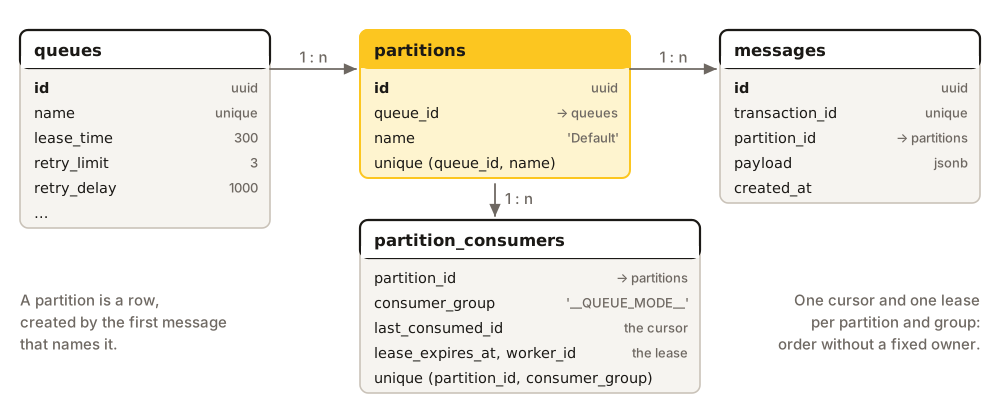
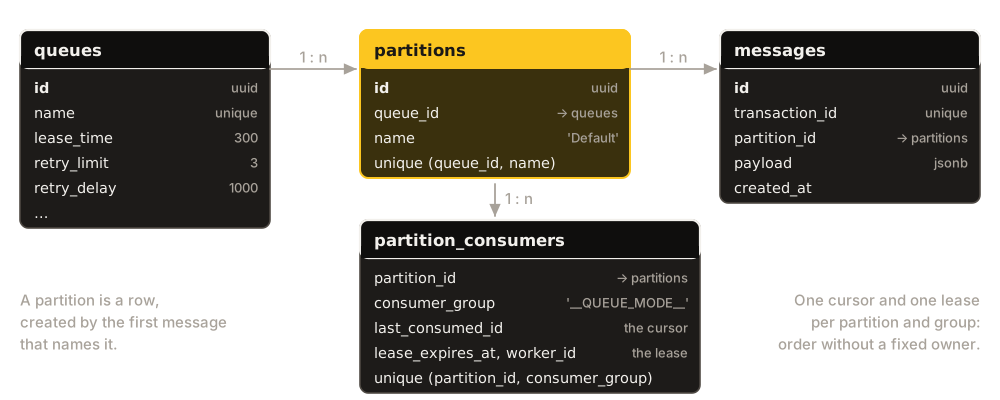
It was easy, and it worked very well. So in our minds a new model took shape, one that SQL represents very well, with these entities:
- the queue table
- the partition table
- the partition consumer table
- the message table
Like this:
Because we had to solve the same problem in another part of the application, we started to think about a generic solution. The idea was simple: an HTTP API on a Node.js server, which writes to and reads from Postgres tables. After the first MVP, we started to think that something good could come out of it. So we rewrote the MVP in C++, to get a statically typed language with stronger correctness guarantees, and replaced the SQL queries with stored procedures in Postgres. One month after the first idea, that custom broker was running in production, first for the heavy LLM queue, and one week later for all the other original Kafka topics too.
Then, in July 2026, we redesigned the way data was saved in Postgres: no more a row for each message, but segments with offsets. To make it fast, we put a lot of in-memory data structures in the broker to speed up consuming. The new storage was so fast that our C++ design became the bottleneck. After some thought, we decided to rewrite it in Rust, because fast async I/O is much easier to write there than in C++ (no more custom libuv loops: we relied on the Tokio async runtime).
This version was faster than anything we ever needed, but it had one structural issue: the more data you store in the broker, the slower the system becomes. Postgres is fast and configurable, but it is a system you cannot fully tune from the outside: you have to follow its rules.
So we started to think about a new class of queue, stored on disk next to the ones in the database. The idea was sound, and after some tests we decided to remove the Postgres queue engine completely, write the storage on disk ourselves, and replicate it with Raft.
The result of this rewrite is Queen today: a message broker replicated with Raft, with a single leader per tenant, able to sustain millions of messages per second at low latency, with a virtually unlimited number of partitions.