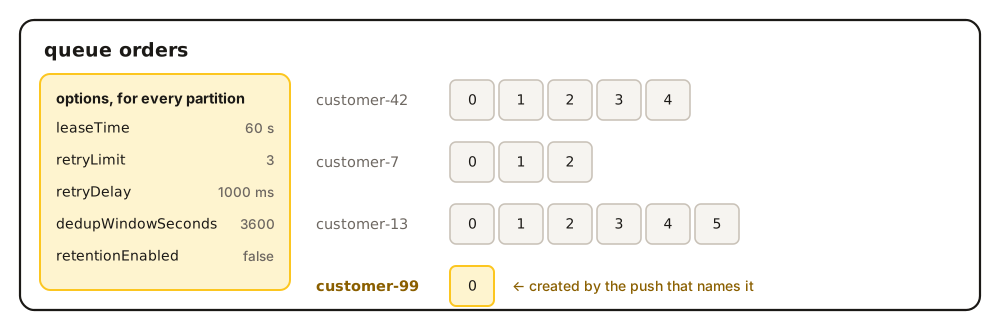
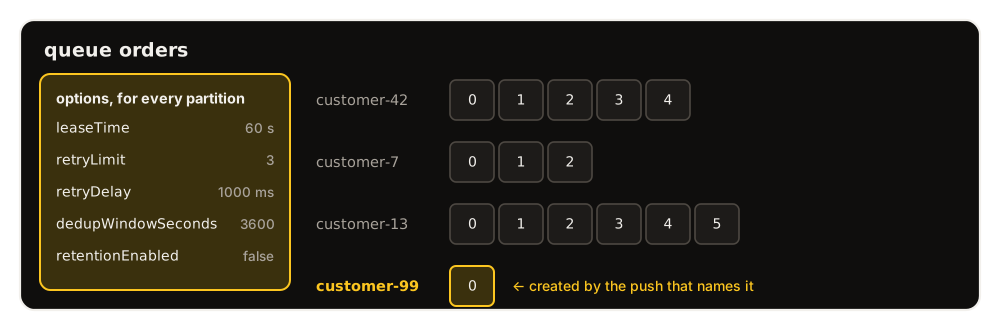
A queue is a named set of partitions that share one configuration. You never have to create one: the first push that names a queue creates it, with the defaults. Configure it when you want other settings.
import { Queen } from 'queen-mq'

const queen = new Queen({ url: 'http://localhost:6632' })

await queen.queue('orders')
  .namespace('shop')              // groups queues in the dashboard
  .config({
    leaseTime: 30,                // seconds a worker holds a message before it is redelivered
    retryLimit: 3,                // failures before the message goes to the dead-letter queue
    retentionEnabled: true,       // retention runs only when this is on
    retentionSeconds: 86400,      // then messages older than a day are removed
  })
  .create()
from queen import Queen
queen = Queen(url="http://localhost:6632")
await (
queen.queue("orders")
.namespace("shop") # groups queues in the dashboard
.config({
"leaseTime": 30, # seconds a worker holds a message before it is redelivered
"retryLimit": 3, # failures before the message goes to the dead-letter queue
"retentionEnabled": True, # retention runs only when this is on
"retentionSeconds": 86400, # then messages older than a day are removed
})
.create()
)import queen "github.com/smartpricing/queen/clients/client-go/v2"
ctx := context.Background()
client, err := queen.New("http://localhost:6632")
if err != nil {
log.Fatal(err)
}
_, err = client.Queue("orders").
Namespace("shop"). // groups queues in the dashboard
Config(queen.QueueConfig{
LeaseTime: 30, // seconds a worker holds a message before it is redelivered
RetryLimit: 3, // failures before the message goes to the dead-letter queue
RetentionEnabled: true, // retention runs only when this is on
RetentionSeconds: 86400, // then messages older than a day are removed
}).
Create().
Execute(ctx)
if err != nil {
log.Fatal(err)
}use queen_mq::{Config, Queen, QueueOptions};
let queen = Queen::connect(Config::new("http://localhost:6632"))?;
queen
.queue("orders")
.namespace("shop") // groups queues in the dashboard
.configure(QueueOptions {
lease_time: Some(30), // seconds a worker holds a message before it is redelivered
retry_limit: Some(3), // failures before the message goes to the dead-letter queue
retention_enabled: Some(true), // retention runs only when this is on
retention_seconds: Some(86400), // then messages older than a day are removed
..Default::default()
})
.await?;use Queen\Queen;
$queen = new Queen('http://localhost:6632');
$queen->queue('orders')
->namespace('shop') // groups queues in the dashboard
->config([
'leaseTime' => 30, // seconds a worker holds a message before it is redelivered
'retryLimit' => 3, // failures before the message goes to the dead-letter queue
'retentionEnabled' => true, // retention runs only when this is on
'retentionSeconds' => 86400, // then messages older than a day are removed
])
->create()
->execute();#include "queen_client.hpp"
using json = nlohmann::json;
queen::QueenClient client("http://localhost:6632");
// QueueConfig has no retentionEnabled, so the options go to the broker's
// configure route through the client's own HTTP layer.
client.get_http_client()->post("/api/v1/configure", {
{"queue", "orders"},
{"namespace", "shop"}, // groups queues in the dashboard
{"options", {
{"leaseTime", 30}, // seconds a worker holds a message,
// then it is redelivered
{"retryLimit", 3}, // failures before the message goes
// to the dead-letter queue
{"retentionEnabled", true}, // retention runs only when this is on
{"retentionSeconds", 86400}, // then messages older than a day are removed
}},
});Every option
Here is a queue that sets most of them, and the table below says what each one does.
await queen.queue('jobs')
  .config({
    leaseTime: 120,                   // 2 minutes per job, then it goes to another worker
    retryLimit: 5,                    // after 5 failures, the dead-letter queue
    retryDelay: 10000,                // a failed job comes back after 10 s, not at once
    delayedProcessing: 30,            // a new job waits 30 s before anyone can take it
    windowBuffer: 5,                  // a burst waits 5 s, then is handed over at once
    dedupWindowSeconds: 86400,        // a transactionId is remembered for a day
    retentionEnabled: true,           // retention runs only when this is on:
    completedRetentionSeconds: 3600,  //   jobs every group has finished go after an hour
    maxWaitTimeSeconds: 604800,       // anything older than a week goes, finished or not
  })
  .create()
await queen.queue("jobs").config({
"leaseTime": 120, # 2 minutes per job, then it goes to another worker
"retryLimit": 5, # after 5 failures, the dead-letter queue
"retryDelay": 10000, # a failed job comes back after 10 s, not at once
"delayedProcessing": 30, # a new job waits 30 s before anyone can take it
"windowBuffer": 5, # a burst waits 5 s, then is handed over at once
"dedupWindowSeconds": 86400, # a transactionId is remembered for a day
"retentionEnabled": True, # retention runs only when this is on:
"completedRetentionSeconds": 3600, # jobs every group has finished go after an hour
"maxWaitTimeSeconds": 604800, # anything older than a week goes, finished or not
}).create()_, err = client.Queue("jobs").
Config(queen.QueueConfig{
LeaseTime: 120, // 2 minutes per job, then another worker
RetryLimit: 5, // after 5 failures, the dead-letter queue
RetryDelayMillis: 10000, // a failed job is back after 10 s, not at once
DelayedProcessing: 30, // a new job waits 30 s before anyone takes it
WindowBuffer: 5, // a burst waits 5 s, then is handed over at once
DedupWindowSeconds: 86400, // a transactionId is remembered for a day
RetentionEnabled: true, // retention runs only when this is on:
CompletedRetentionSeconds: 3600, // jobs all groups finished go after an hour
MaxWaitTimeSeconds: 604800, // anything over a week old goes, finished or not
}).
Create().
Execute(ctx)
if err != nil {
log.Fatal(err)
}let options = QueueOptions {
lease_time: Some(120), // 2 minutes per job, then to another worker
retry_limit: Some(5), // after 5 failures, the dead-letter queue
retry_delay: Some(10000), // a failed job returns after 10 s, not at once
delayed_processing: Some(30), // a new job waits 30 s before anyone takes it
window_buffer: Some(5), // a burst waits 5 s, then goes out as one
dedup_window_seconds: Some(86400), // a transactionId is remembered for a day
retention_enabled: Some(true), // retention runs only when this is on:
completed_retention_seconds: Some(3600), // jobs all groups finished go after an hour
max_wait_time_seconds: Some(604800), // older than a week: gone, finished or not
..Default::default()
};
queen.queue("jobs").configure(options).await?;$queen->queue('jobs')->config([
'leaseTime' => 120, // 2 minutes per job, then another worker gets it
'retryLimit' => 5, // after 5 failures, the dead-letter queue
'retryDelay' => 10000, // a failed job comes back after 10 s, not at once
'delayedProcessing' => 30, // a new job waits 30 s before anyone can take it
'windowBuffer' => 5, // a burst waits 5 s, then is handed over at once
'dedupWindowSeconds' => 86400, // a transactionId is remembered for a day
'retentionEnabled' => true, // retention runs only when this is on:
'completedRetentionSeconds' => 3600, // jobs every group has finished go after an hour
'maxWaitTimeSeconds' => 604800, // anything older than a week goes, finished or not
])->create()->execute();// QueueConfig has none of retryDelay, dedupWindowSeconds, retentionEnabled and
// maxWaitTimeSeconds, so the options go to the broker's configure route
// through the client's own HTTP layer.
json options = {
{"leaseTime", 120}, // 2 minutes per job, then another worker
{"retryLimit", 5}, // after 5 failures, the dead-letter queue
{"retryDelay", 10000}, // a failed job returns after 10 s, not at once
{"delayedProcessing", 30}, // a new job waits 30 s before anyone takes it
{"windowBuffer", 5}, // a burst waits 5 s, then goes out at once
{"dedupWindowSeconds", 86400}, // a transactionId is remembered for a day
{"retentionEnabled", true}, // retention runs only when this is on:
{"completedRetentionSeconds", 3600}, // jobs all groups finished go after an hour
{"maxWaitTimeSeconds", 604800}, // older than a week goes, finished or not
};
client.get_http_client()->post("/api/v1/configure",
{{"queue", "jobs"}, {"options", options}});| Option | Default | What it does |
|---|---|---|
leaseTime |
60 s (300 s from create()) |
How long a worker holds the messages it took before they go to another worker. |
retryLimit |
3 | How many failed attempts a message gets. After the last one it goes to the dead-letter queue. |
retryDelay |
1000 ms | How long a failed message waits before it comes back. Its partition waits with it, for that consumer group. |
deadLetterQueue, dlqAfterMaxRetries |
true | File a message that ran out of retries in the dead-letter queue. With both off, it is dropped. |
delayedProcessing |
0 s | How long every new message waits after its push before anyone can take it. |
windowBuffer |
0 s | How long new messages wait in their partition, so a burst is handed over as one batch. |
dedupWindowSeconds |
3600 s | How long a partition remembers transactionIds. 0 turns deduplication off. |
retentionEnabled |
false | Must be true for the two options below to do anything. |
retentionSeconds |
0 | Remove messages older than this, consumed or not. |
completedRetentionSeconds |
0 | Remove messages older than this that every consumer group has already acked. |
maxWaitTimeSeconds |
0 | Remove messages older than this, consumed or not. Works without retentionEnabled. |
encryptionEnabled |
false | Encrypt payloads on disk. Every node needs QUEEN_ENCRYPTION_KEY. |
namespace, task |
from the name | Labels that group queues in the dashboard and in a discovery pop. |
Leases. A worker that takes messages holds them under a lease. Until it acks them or the lease runs out, no other worker of the same consumer group gets that partition.
Retries. A failed message comes back retryLimit times, each time after retryDelay, and then goes to the dead-letter queue.
Delays. delayedProcessing holds every new message of the queue for a while. windowBuffer holds a group’s new messages until the burst is over, so the handler gets them together.
Deduplication. Inside the dedup window, a second push with the same transactionId in the same partition is not written.
Retention. By default Queen keeps every message, and the disk grows. Retention runs only when retentionEnabled is true; then retentionSeconds removes old messages, read or not, and completedRetentionSeconds removes old messages that every group has finished. maxWaitTimeSeconds removes old messages without needing retentionEnabled. A node whose disk is 85% full refuses the writes that would grow it.
Encryption. With encryptionEnabled, payloads are encrypted on disk.
Three traps
config(...).create()in the JavaScript client sends your options together with the client’s own defaults (a 300-second lease, encryption off, no retention). Calling it on an existing queue resets every option you leave out. Name every option you care about.- On a node without
QUEEN_ENCRYPTION_KEY, an encrypted queue stores plain text, and nothing warns you. priority,ttl,maxSizeandminPopWaitTimeare accepted and stored, and do nothing.- The C++ client cannot set
retentionEnabled,retryDelay,dedupWindowSecondsormaxWaitTimeSeconds, so its code above posts to/api/v1/configureitself. A C++ queue configured withretention_secondsalone never runs retention.
See also
- Push: the first push creates the queue and the partition.
- Configuration for different use cases: retention and disk on the broker side.
- Limits: name rules and the bounds of every option.