On Kubernetes a cluster is a StatefulSet of three pods. Each pod gets its own volume, the pods find each other through a headless Service, a second Service carries port 6632 to clients, and a disruption budget lets Kubernetes evict only one pod at a time. There are two ways to run it: a plain manifest you apply yourself, or the operator, which runs the same cluster from one object.
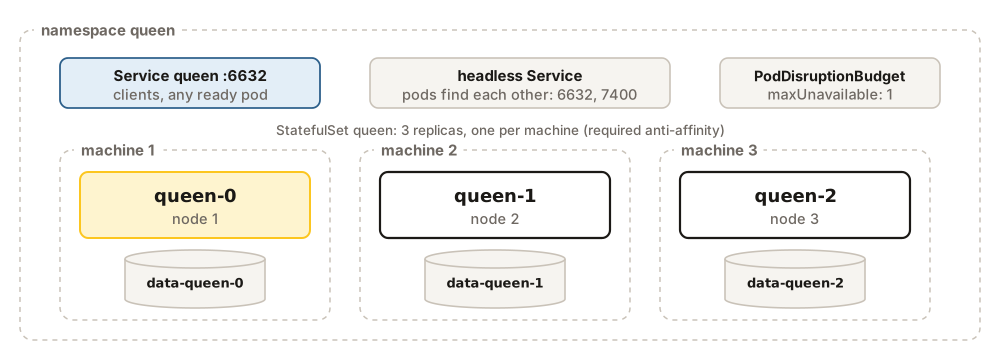
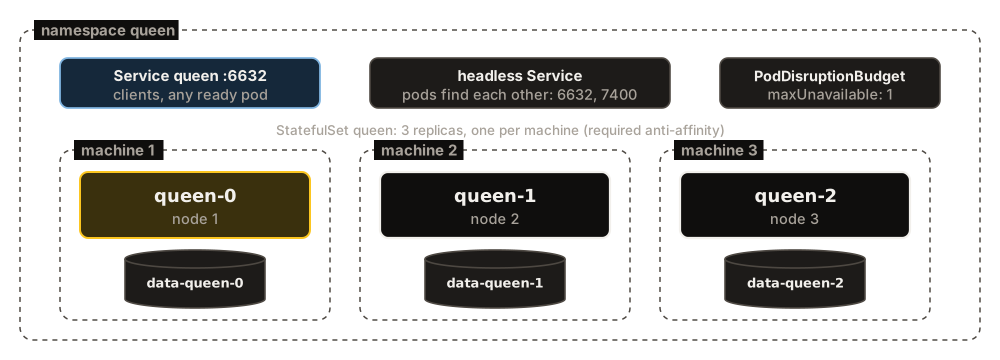
The repository ships no Helm chart. The complete manifest is below, ready to copy or to put in your own chart.
The secret
Both ways start with a namespace and a secret: the token the nodes share, and the key that encrypts payloads on disk.
kubectl create namespace queen
kubectl -n queen create secret generic queen \
  --from-literal=QUEEN_RAFT_TOKEN="$(openssl rand -hex 32)" \
  --from-literal=QUEEN_ENCRYPTION_KEY="$(openssl rand -hex 32)"
Keep a copy of the encryption key somewhere safe, apart from the cluster. Without it, the payloads of encrypted queues cannot be read, and a backup does not contain it.
The manifest
The manifest is ordinary Kubernetes, but a few fields are there for a reason that is not obvious. Change them only if you know what you lose.
| Field | Value | Why |
|---|---|---|
podManagementPolicy |
Parallel | With publishNotReadyAddresses, lets all pods start together. Without both, a full restart never ends: no pod is ready without a leader, and no leader is elected until the pods can find each other. |
publishNotReadyAddresses |
true | On the headless Service, for the same reason. |
QUEEN_RAFT_NODE_ID |
ordinal | Pod queen-0 is node 1, queen-1 is node 2, and so on. |
readinessProbe |
/health | A pod that does not know a leader, or is behind, gets no clients, and a rolling update waits for it. |
livenessProbe |
TCP on 6632 | Never /health: an election would make every pod fail it, and Kubernetes would restart them all at once. |
terminationGracePeriodSeconds |
90 | A stopping pod hands over its work first, which can take close to a minute. Shorter, and the stop becomes a crash. |
CPU limit |
none | Throttling turns a burst of work into a missed heartbeat. Memory request equals the limit. |
podAntiAffinity |
required | One voter per machine: two voters on one machine turn its failure into a lost majority. |
After kubectl apply, check that the three nodes formed one cluster:
kubectl -n queen rollout status statefulset/queen
kubectl -n queen exec queen-0 -- curl -s localhost:6632/api/v1/system/raft/membership \
| jq -c '.membership | {leader, term, voters, members: [.members[] | {nodeId, live, lag}]}'{"leader":1,"term":4,"voters":[1,2,3],"members":[{"nodeId":1,"live":true,"lag":0},...]}Three voters, all live, none behind. Clients use the queen Service and can land on any pod.
The operator
A StatefulSet cannot add a voter, replace a node whose volume is lost, or grow its volumes, and its rolling update moves on as soon as a pod is Ready. The operator does those steps for you, through the same HTTP API you would use. Install it once:
kubectl apply -f \
  https://raw.githubusercontent.com/queen-mq/queen/master/deploy/operator/install.yaml
Then, with the secret above, a cluster is one object:
apiVersion: queenmq.com/v1alpha1
kind: QueenCluster
metadata:
  name: queen
  namespace: queen
spec:
  version: "2.6.0"
  replicas: 3
  secretName: queen
  storage:
    size: 50Gi
kubectl -n queen get queencluster
NAME VERSION VOTERS COMMITS PHASE AGE
queen 2.6.0 [1,2,3] true Ready 40sCOMMITS is a write the operator makes once a minute: true while the cluster can commit. The pods and Services have the same names as in the manifest.
v1alpha1, and a field may still change.Four things to know
- Scaling the StatefulSet does not add a voter. The members live in the log. Add or remove voters through the membership API, or change
replicason the operator’s object. - Some things are fixed at the first start: the StatefulSet, Service and namespace names (they are part of the node addresses), and the ports.
- Delete one volume at a time, and remove the member first. In a test, deleting two volumes at once left a cluster that could not commit while every pod said Ready.
- Pin the image version. A pod that restarts on
latestpulls whatever is current that day. An upgrade should be a step you take.
The whole manifest
A headless Service for the nodes, a Service for the clients, the StatefulSet and a disruption budget. The fields in the table above are marked where they are set.
apiVersion: v1
kind: Service
metadata: { name: queen }
spec:
  selector: { app: queen }
  ports: [{ name: http, port: 6632, targetPort: http }]
---
apiVersion: v1
kind: Service
metadata: { name: queen-headless }
spec:
  clusterIP: None
  publishNotReadyAddresses: true
  selector: { app: queen }
  ports:
    - { name: http, port: 6632, targetPort: http }
    - { name: raft, port: 7400, targetPort: raft }
---
apiVersion: policy/v1
kind: PodDisruptionBudget
metadata: { name: queen }
spec:
  maxUnavailable: 1
  selector: { matchLabels: { app: queen } }
---
apiVersion: apps/v1
kind: StatefulSet
metadata: { name: queen }
spec:
  replicas: 3
  serviceName: queen-headless
  podManagementPolicy: Parallel
  minReadySeconds: 30
  updateStrategy: { type: RollingUpdate }
  selector: { matchLabels: { app: queen } }
  template:
    metadata: { labels: { app: queen } }
    spec:
      terminationGracePeriodSeconds: 90
      securityContext: { runAsNonRoot: true, runAsUser: 65532, runAsGroup: 65532, fsGroup: 65532 }
      affinity:
        podAntiAffinity:
          requiredDuringSchedulingIgnoredDuringExecution:
            - topologyKey: kubernetes.io/hostname
              labelSelector: { matchLabels: { app: queen } }
      topologySpreadConstraints:
        - { maxSkew: 1, topologyKey: topology.kubernetes.io/zone, whenUnsatisfiable: ScheduleAnyway,
            labelSelector: { matchLabels: { app: queen } } }
      containers:
        - name: queen
          image: ghcr.io/queen-mq/queen:2.6.0
          ports:
            - { name: http, containerPort: 6632 }
            - { name: raft, containerPort: 7400 }
          env:
            - { name: QUEEN_RAFT_REPLICATOR, value: openraft }
            - { name: QUEEN_RAFT_DIR, value: /var/lib/queen/raft }
            - { name: QUEEN_RAFT_NODE_ID, value: ordinal }
            - name: QUEEN_RAFT_PEERS
              value: "1=queen-0.queen-headless.queen.svc.cluster.local:7400/queen-0.queen-headless.queen.svc.cluster.local:6632,2=queen-1.queen-headless.queen.svc.cluster.local:7400/queen-1.queen-headless.queen.svc.cluster.local:6632,3=queen-2.queen-headless.queen.svc.cluster.local:7400/queen-2.queen-headless.queen.svc.cluster.local:6632"
            - name: QUEEN_RAFT_TOKEN
              valueFrom: { secretKeyRef: { name: queen, key: QUEEN_RAFT_TOKEN } }
            - name: QUEEN_ENCRYPTION_KEY
              valueFrom: { secretKeyRef: { name: queen, key: QUEEN_ENCRYPTION_KEY } }
            - name: QUEEN_SERVER_ID
              valueFrom: { fieldRef: { fieldPath: metadata.name } }
            - { name: QUEEN_LOG_JSON, value: "true" }
          resources:
            requests: { cpu: "1", memory: 4Gi }
            limits: { memory: 4Gi }
          startupProbe:   { tcpSocket: { port: http }, periodSeconds: 5, timeoutSeconds: 5, failureThreshold: 360 }
          readinessProbe: { httpGet: { path: /health, port: http }, periodSeconds: 5, timeoutSeconds: 5, failureThreshold: 3 }
          livenessProbe:  { tcpSocket: { port: http }, periodSeconds: 20, timeoutSeconds: 5, failureThreshold: 3 }
          lifecycle: { preStop: { exec: { command: ["/bin/sleep", "5"] } } }
          securityContext: { allowPrivilegeEscalation: false, readOnlyRootFilesystem: true, capabilities: { drop: ["ALL"] } }
          volumeMounts:
            - { name: data, mountPath: /var/lib/queen/raft }
            - { name: tmp, mountPath: /tmp }
      volumes: [{ name: tmp, emptyDir: {} }]
  volumeClaimTemplates:
    - metadata: { name: data }
      spec:
        accessModes: ["ReadWriteOnce"]
        resources: { requests: { storage: 50Gi } }