The broker can copy its queues into an S3 bucket, as JSONL or Parquet files in folders that DuckDB, Spark or ClickHouse read directly. The sink runs inside the broker, on every node of a cluster, and it is exactly once: each record lands in one file, and a crash or a retried upload rewrites the same bytes under the same name instead of adding a copy.
Turn it on
Any S3-compatible service works. Our test used a versitygw gateway named s3 on the same Docker network:
docker run -d --name queen --network lake -p 6632:6632 \
  -v /var/lib/queen:/var/lib/queen/raft \
  -e QUEEN_S3_EMBEDDED=true \
  -e QUEEN_S3_QUEUES=orders \
  -e QUEEN_S3_ENDPOINT=http://s3:7070 \
  -e QUEEN_S3_REGION=us-east-1 \
  -e QUEEN_S3_PATH_STYLE=true \
  -e QUEEN_S3_BUCKET=lake \
  -e QUEEN_S3_ACCESS_KEY=queen \
  -e QUEEN_S3_SECRET_KEY=queen-secret-key \
  -e QUEEN_S3_START=earliest \
  -e QUEEN_S3_MAX_WINDOW_MS=10000 \
  ghcr.io/queen-mq/queen:2.6.0
The last two lines are for the demo: earliest copies the queue from its first record, and a file closes after ten seconds instead of five minutes. Push three messages:
curl -s -X POST localhost:6632/api/v1/push -H 'content-type: application/json' -d '{"items":[
  {"queue":"orders","partition":"cust-1","payload":{"order":1,"status":"new","total":42.00}},
  {"queue":"orders","partition":"cust-2","payload":{"order":2,"status":"new","total":17.50}},
  {"queue":"orders","partition":"cust-1","payload":{"order":1,"status":"paid","total":42.00}}
]}' >/dev/null
curl -s localhost:6632/status \
  | jq -c '.s3.sinks[0].queues[0] | {state, k, windowsCommitted, records}'
{"state":"filling","k":1,"windowsCommitted":1,"records":3}
About ten seconds later window 1 was in the bucket, as two files: the data and its manifest.
queen/tenant=00000000-0000-0000-0000-000000000001/queue=orders/dt=2026-10-24/hour=10/
  w-0000000001-1792836000000000-1792837437745538.jsonl.zst
queen/_queen/tenant=00000000-0000-0000-0000-000000000001/queue=orders/windows/0000000001.json
The data file holds one line per record, sorted by partition and offset:
{"partition":"cust-1","offset":0,"transactionId":"01a16d70-3e1e-7001-9fb4-299167829f1d",
 "ts":"2026-10-24T10:23:54.910988Z","payload":{"order":1,"status":"new","total":42.00}}
{"partition":"cust-1","offset":1,...,"payload":{"order":1,"status":"paid","total":42.00}}
{"partition":"cust-2","offset":0,...,"payload":{"order":2,"status":"new","total":17.50}}
The payload is the producer’s own text, byte for byte: 42.00 is still 42.00.
How it works
The sink cuts each queue into windows of time, on the broker’s clock. A window closes when it holds QUEEN_S3_TARGET_MB of records, when it is QUEEN_S3_MAX_WINDOW_MS old, or at the next hour. Once a window is closed, no record can join it, so building it again gives the same records in the same order, the same bytes and the same file name. That is the whole exactly-once argument, and it asks nothing special of the bucket.
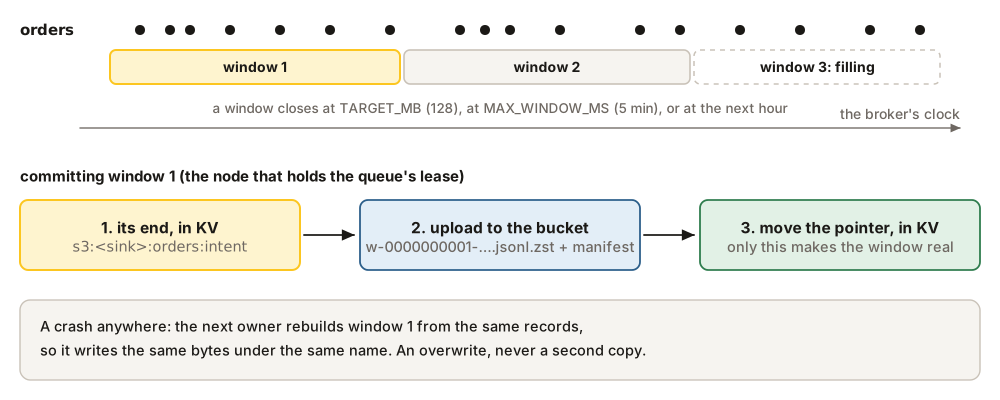
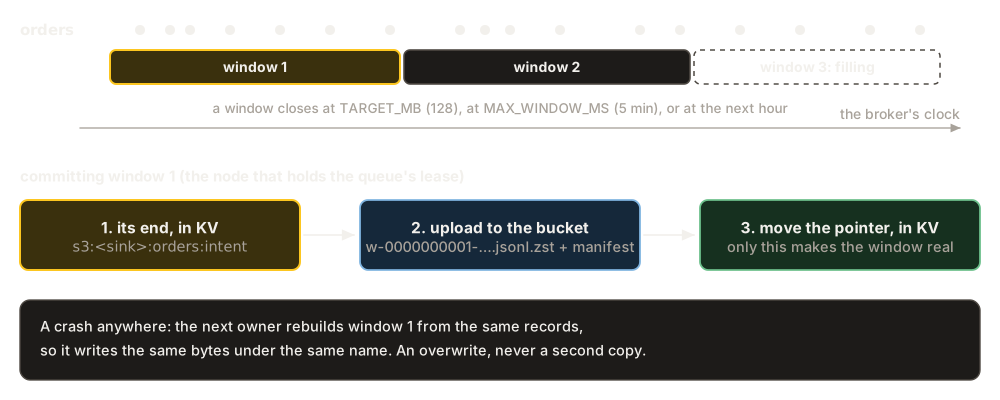
Every node runs the sink, but only one node writes a queue: the one that holds the queue’s lease, a row in Queen’s KV. A window is committed in three steps: its end is written in KV, the files go up, then a commit pointer moves in KV. A node that dies halfway leaves the next one enough to finish the same window. The queues spread over the nodes by themselves.
| Setting | Default | What it does |
|---|---|---|
QUEEN_S3_EMBEDDED |
false | Starts the sink on this node. |
QUEEN_S3_QUEUES |
required | The queues to copy, comma-separated, or * for all. |
QUEEN_S3_ENDPOINT, _REGION, _BUCKET |
required | Where the bucket is. |
QUEEN_S3_ACCESS_KEY, _SECRET_KEY |
required | The credentials. The secret is never logged. |
QUEEN_S3_PATH_STYLE |
false | true puts the bucket in the URL path, as most self-hosted services want. |
QUEEN_S3_FORMAT |
jsonl | jsonl or parquet. |
QUEEN_S3_START |
latest | Where a new queue starts: latest, or earliest for what retention still holds. |
QUEEN_S3_TARGET_MB |
128 | Uncompressed megabytes that close a window. |
QUEEN_S3_MAX_WINDOW_MS |
300000 | The longest a window stays open. |
QUEEN_S3_SSE |
unset | AES256 or aws:kms: encryption of the files in the bucket. |
Four things to know
- The bucket copies the log, not what consumers did. A message a group nacked or sent to the dead-letter queue is in the bucket like any other.
- The bucket is plain text. The sink decrypts encrypted queues before it writes them, so give the bucket encryption of its own (
QUEEN_S3_SSE, or the bucket’s default). - Retention can delete records before the sink reads them. The loss is never silent (the manifest lists the lost range), but you can rule it out: with
"retentionSinkHold":"default"on the queue, retention waits for the sink, up to seven days. - Watch
queen_s3_lag_seconds: how far behind the bucket is. It climbs to a little more than one window on a busy queue, then drops when the window commits.
See also
- Configuration reference: every
QUEEN_S3_*setting. - Windowed aggregation: finished traces copied to a bucket.