A write goes through four steps.
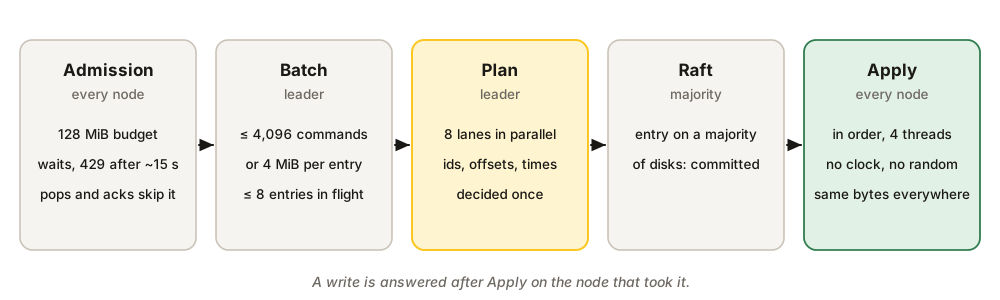
Admission. Every node has a memory budget for the writes waiting to be planned (128 MiB by default). A push takes its share before its body is read. When the budget is full, the push waits, so a fast producer just slows down. After about 15 seconds it gets a 429, and the client tries again. Pops and acks never wait here. We added this after a broker filled 10 GB of memory with waiting requests and was killed.
Batch. The leader collects up to 4,096 commands (or 4 MiB) and plans them together, as one log entry. Up to eight entries are in flight at the same time. A retried request is found by its id and gets the answer it missed, so nothing is planned twice.
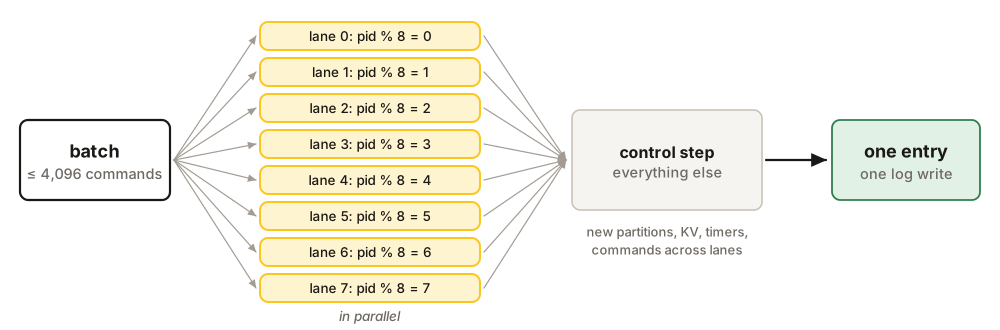
Plan. The planner decides what each command means right now, and writes the answer down as facts: “append these messages to partition 17, at offsets 4,210 to 4,309, at this microsecond”. Ids, offsets and times are chosen here, once. To use more cores, eight lanes plan in parallel: each lane owns a share of the partitions, and one last step plans what touches more than one lane.
Apply. Every node executes the committed entries, in order. Apply reads no clock and no random number, so every node ends with the same bytes. Four threads apply the work of different partitions at the same time.