When a booking is confirmed, send booking.confirmed to the customer’s URL. Their server fails sometimes, and a crash at the wrong moment can make you call it twice.
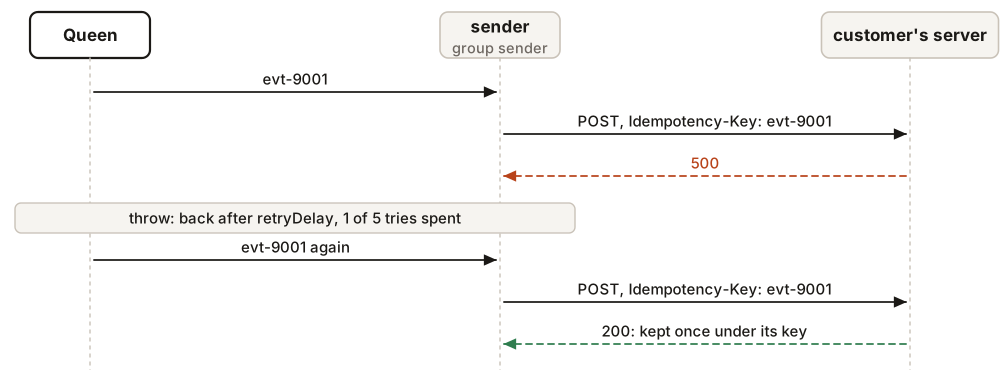
One message per call, in a queue with retries (retryLimit: 5 and a retryDelay). The handler throws when the call fails: the message comes back after the delay, and goes to the dead-letter queue after the last try. The message’s transactionId travels as the Idempotency-Key, so the receiver can drop a second call.
const stop = new AbortController()
process.once('SIGTERM', () => stop.abort())       // a deploy stops the sender cleanly

await queen.queue('webhooks')
  .group('sender')
  .subscriptionMode('all')
  .each()
  .consume(async (msg) => {
    const res = await fetch(msg.data.url, {
      method: 'POST',
      headers: { 'content-type': 'application/json', 'idempotency-key': msg.transactionId },
      body: JSON.stringify(msg.data.event),
    })
    if (!res.ok) throw new Error(`HTTP ${res.status}`)  // retried, then dead-lettered
  }, { signal: stop.signal })
import httpx
stop = asyncio.Event()
loop = asyncio.get_running_loop()
loop.add_signal_handler(signal.SIGTERM, stop.set) # a deploy stops the sender cleanly
async with httpx.AsyncClient() as client:
async def call(msg):
res = await client.post(
msg["data"]["url"],
json=msg["data"]["event"],
headers={"idempotency-key": msg["transactionId"]},
)
res.raise_for_status() # retried, then dead-lettered
await (
queen.queue("webhooks")
.group("sender")
.subscription_mode("all")
.each()
.consume(call, signal=stop)
)ctx, stop := signal.NotifyContext(ctx, syscall.SIGTERM) // a deploy stops it cleanly
defer stop()
err := client.Queue("webhooks").
Group("sender").
SubscriptionMode(queen.SubscriptionModeAll).
Each().
Consume(ctx, func(ctx context.Context, msg *queen.Message) error {
event, err := json.Marshal(msg.Data["event"])
if err != nil {
return err
}
req, err := http.NewRequestWithContext(ctx, http.MethodPost,
msg.Data["url"].(string), bytes.NewReader(event))
if err != nil {
return err
}
req.Header.Set("Content-Type", "application/json")
req.Header.Set("Idempotency-Key", msg.TransactionID)
res, err := http.DefaultClient.Do(req)
if err != nil {
return err
}
res.Body.Close()
if res.StatusCode >= 300 {
return fmt.Errorf("HTTP %d", res.StatusCode) // retried, then dead-lettered
}
return nil
}).
Execute(ctx) // returns once ctx is cancelled
if err != nil {
log.Fatal(err)
}use queen_mq::Cancel;
use tokio::signal::unix::{signal, SignalKind};
let stop = Cancel::new();
let on_sigterm = stop.clone();
tokio::spawn(async move { // a deploy stops the sender cleanly
if let Ok(mut sigterm) = signal(SignalKind::terminate()) {
sigterm.recv().await;
on_sigterm.cancel();
}
});
let http = reqwest::Client::new();
queen
.queue("webhooks")
.group("sender")
.subscription_mode(SubscriptionMode::All)
.poll_timeout(Duration::from_secs(5)) // a stop waits for the poll in flight (5 s)
.cancel(stop)
.consume(move |msg: Message| {
let http = http.clone();
async move {
let res = http
.post(msg.data["url"].as_str().unwrap_or_default())
.header("idempotency-key", &msg.transaction_id)
.json(&msg.data["event"])
.send()
.await
.map_err(|e| e.to_string())?;
if !res.status().is_success() {
// an Err is retried after retryDelay, then dead-lettered
return Err(format!("HTTP {}", res.status().as_u16()));
}
Ok(())
}
})
.await?;// A deploy's SIGTERM stops the sender cleanly: consume() handles it itself.
$http = new GuzzleHttp\Client();
$queen->queue('webhooks')
->group('sender')
->subscriptionMode('all')
->each()
->consume(function (array $msg) use ($http) {
$res = $http->post($msg['data']['url'], [
'headers' => ['idempotency-key' => $msg['transactionId']],
'json' => $msg['data']['event'],
'http_errors' => false,
]);
if ($res->getStatusCode() >= 300) { // retried, then dead-lettered
throw new RuntimeException("HTTP {$res->getStatusCode()}");
}
})
->execute();static std::atomic<bool> stop{false}; // static: a signal handler sees it
std::signal(SIGTERM, [](int) { stop = true; }); // a deploy stops the sender cleanly
client.queue("webhooks")
.group("sender")
.subscription_mode("all")
.each()
.wait(false) // short polls: the stop flag is read between them
.consume([](const json& msg) {
const std::string url = msg["data"]["url"]; // http://host:port/path
const size_t path = url.find('/', url.find("//") + 2);
httplib::Client http(url.substr(0, path));
httplib::Headers headers = {
{"idempotency-key", msg["transactionId"].get<std::string>()}};
auto res = http.Post(url.substr(path), headers, msg["data"]["event"].dump(),
"application/json");
if (!res || res->status / 100 != 2) { // retried, then dead-lettered
throw std::runtime_error("HTTP " + std::to_string(res ? res->status : 0));
}
}, &stop);The receiver failed the first call. The message came back after the delay, the second call worked, and the receiver kept the event once, under evt-9001.
One thing to know: a failed message holds its partition for the delay. Use one partition per customer, so a customer whose server is down waits on its own retries alone.
Built from: Retries and DLQ, Acknowledge.