A broker that promises “all or nothing” has to keep the promise exactly when something breaks. We test QueenMQ with Jepsen on five nodes, under kill -9, network partitions, paused processes, clock jumps, power loss and corrupted files. This page says what each API guarantees, what an answered write means, and where the guarantees stop.
What each API guarantees
| API | Guarantee |
|---|---|
| KV, one key | Linearizable. |
| KV, several keys in one call | Strict serializable. |
KV putIfAbsent |
One winner. |
KV incr |
No lost and no doubled increments, for every call the broker committed. |
| Push, and reads by offset | No acked message lost or duplicated. One order per partition for every reader, with offsets that have no gaps. |
| Pop and ack | No acked message lost, none acked twice, none delivered again after a successful ack. Leases are exclusive in real time. Order per partition, with no skips. |
| Transactions | Atomic, and each input’s effects applied exactly once. |
transactionId dedup |
A retry gets the original offset, across a change of leader too. |
| Locks | One acquire wins, a later holder has a higher token, and a transaction guarded by a lock commits only while the token is still the lock’s. |
| Timers | A timer fires at most once, never after a cancel that reported removing it, and never before its delay. |
| Every answered write, with two exceptions below | Survives kill -9 and power loss. |
The campaign on the code of 2.6.0 ran 257 tests, and all were valid. Jepsen lists every campaign, every fault, and every bug the earlier campaigns found and we fixed.
What an answered write means
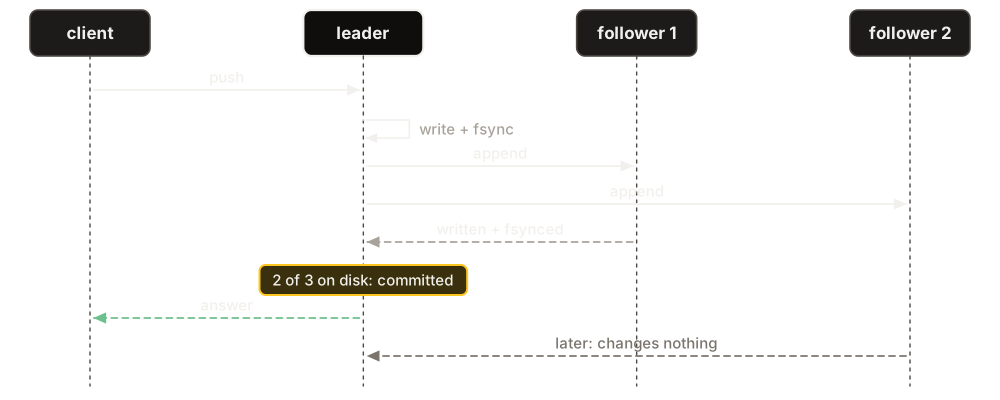
A write is answered only after its entry is committed: a majority of the nodes have written it and synced it to disk (fsync). A single node syncs before it answers.
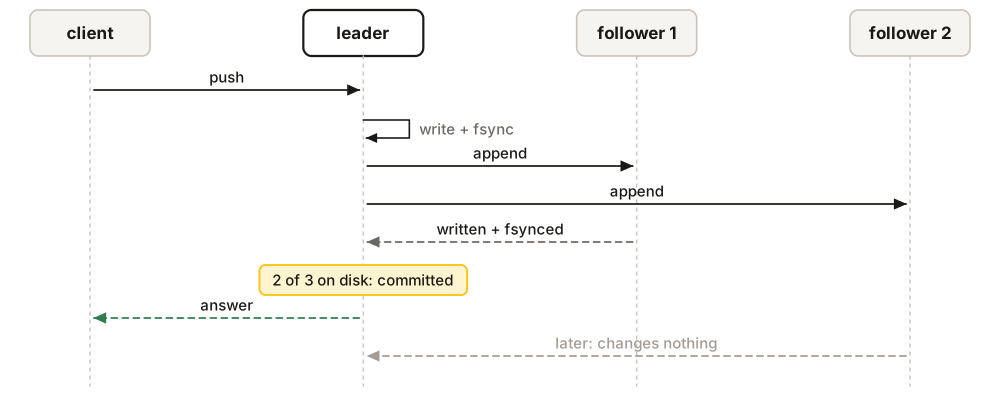
There are two exceptions. Ephemeral queues keep their messages in memory, so a node that crashes loses what it held, by design. QUEEN_CONSUME_FAST=1 (off by default) answers pops and acks before their checkpoint commits, so a change of leader can lose a lease or an ack you were told about.
A 503 means the outcome is not known: the write may still commit (retry, timeout, no_leader, or outcome_unknown on an ack). Send it again with the same ids, and deduplication makes the retry safe. The one 503 after which nothing was applied is standby, from a standby cluster.
What exactly-once means here
| Layer | What holds |
|---|---|
| Delivery | At least once. An expired lease, a nack or a crash delivers a message again. |
| Effects inside QueenMQ | Exactly once, through transactions (the ack and the writes are one entry, fenced by the lease) and transactionId deduplication. |
| A lost answer | A retry of a committed step writes nothing twice when the step carries a gate: a fixed push id or a once marker. Without one, a retry can apply its KV writes and timers again. |
| Calls outside QueenMQ | Not covered. A call to a payment provider is outside any commit: give it an idempotency key from the message. |
Where the guarantees stop
- This is testing, not proof. Jepsen finds bugs; it cannot show there are none.
- The campaigns run the HTTP API on one raft group. The Kafka port, and several raft groups per node, are not in them.
- Clocks. Lease exclusivity across a change of leader needs the nodes’ clocks within 500 ms of each other (
QUEEN_RAFT_MAX_CLOCK_SKEW_MS). - Disks. Losing a majority of the disks for good can lose acked data. Raft survives the loss of a minority, and no more.
- A standby cluster replays the cluster a moment later. Promoting it after the cluster is lost gives up the acked writes it had not read yet.
/healthis not a write. A node cut off from the majority answers 200 for five more seconds. To know a cluster can commit, write to it (see Upgrades and monitoring).