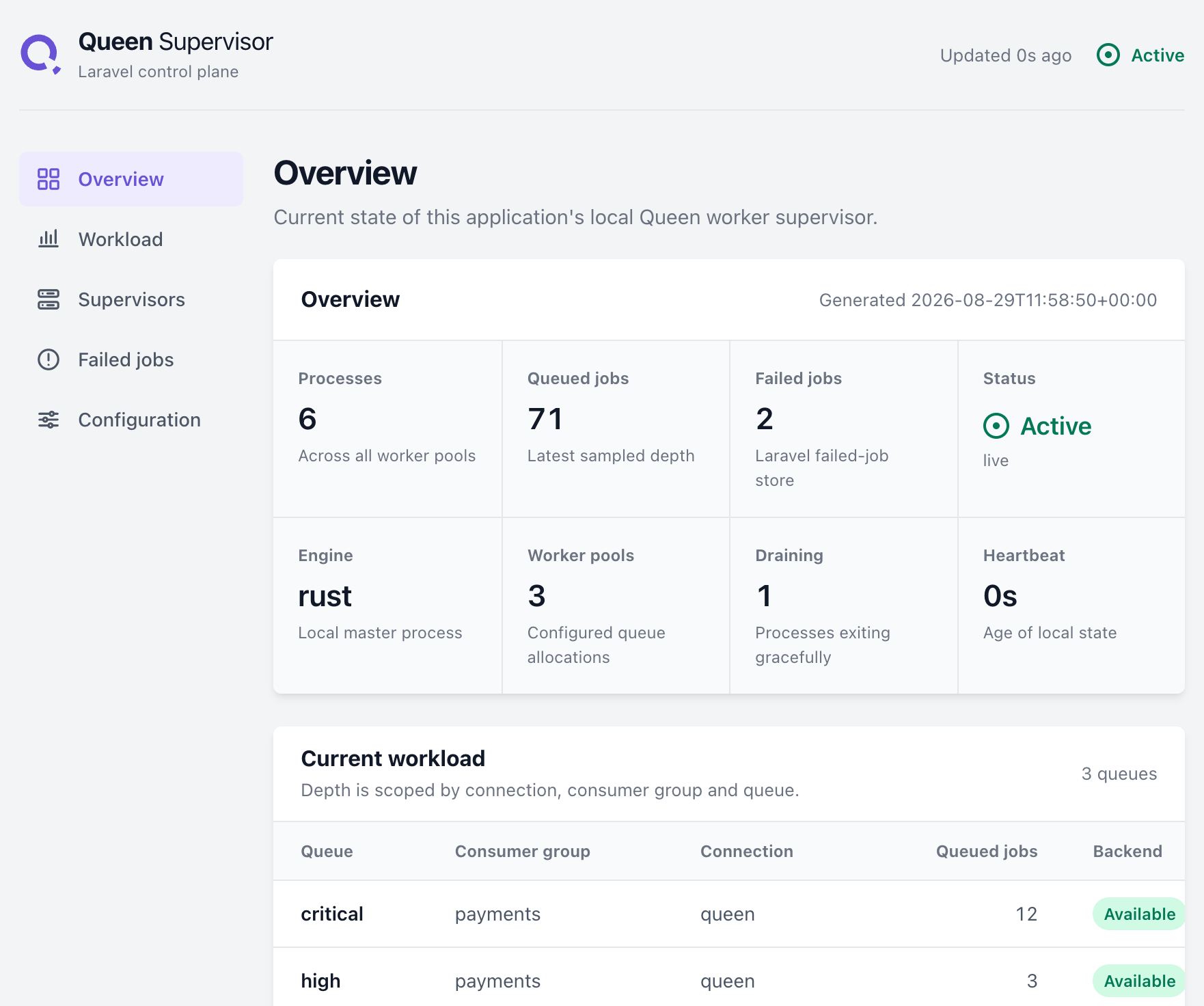
The Laravel panel answers one local question: what is this application’s Queen supervisor doing on this host? It reads the private supervisor state already written by the PHP or Rust engine. It does not poll the broker again and it is not a replacement for Queen’s global broker dashboard.
The route is absent by default.
Enable it locally
QUEEN_DASHBOARD_ENABLED=true
QUEEN_DASHBOARD_PATH=queen
QUEEN_DASHBOARD_REFRESH_SECONDS=5
QUEEN_DASHBOARD_FAILED_JOBS_LIMIT=50
Open /queen. Local and testing environments may use the built-in local allowance while
queen.dashboard.allow_local is true.
To test the production authorization path locally, disable that allowance:
QUEEN_DASHBOARD_ALLOW_LOCAL=falseChanging the route path, domain, enabled flag or middleware after Laravel has cached routes or configuration requires rebuilding both caches:
php artisan config:clear
php artisan route:clear
php artisan config:cache
php artisan route:cache
Authorize production access
Enabling the route is not enough in production. Queen denies access until the application defines
the viewQueenDashboard Gate ability. Attach application authentication before that Gate runs:
// config/queen.php
'dashboard' => [
    'enabled' => env('QUEEN_DASHBOARD_ENABLED', false),
    'path' => env('QUEEN_DASHBOARD_PATH', 'queen'),
    'middleware' => ['web', 'auth'],
],
use Illuminate\Support\Facades\Gate;
Gate::define('viewQueenDashboard', function ($user): bool {
return $user !== null && $user->canOperateQueues();
});The package always retains Laravel’s web middleware, even if it is omitted from the configured
list. This preserves sessions and CSRF protection for state-changing controls. Put the route behind
the same network and identity controls as any other production administration surface.
What the panel shows
- master engine, PID, state, generation and live/stale heartbeat;
- pools, queues, worker counts and workers currently draining;
- last queue depth already sampled by the supervisor;
- restart and circuit state;
- a safe allowlist of worker settings;
- bounded metadata from supported Laravel database or file failed-job stores.
The read model never returns broker endpoints, bearer tokens, custom headers, filesystem paths, job payloads, exception bodies or raw backend errors. Unsupported or unavailable failed stores are shown as unavailable instead of falling back to an unbounded read.
What the panel controls
The three controls apply to the complete local master:
| Control | Effect |
|---|---|
| Pause | Drain current workers and start no replacements |
| Continue | Resume reconciliation and start workers as needed |
| Terminate | Drain, stop the master and let the outer process monitor restart it if configured |
Each form carries the exact supervisor instance_id. An old page cannot pause or terminate a
replacement generation. Queen also refuses a second pending command instead of overwriting the
first one.
| HTTP result | Meaning |
|---|---|
404 |
Dashboard disabled at runtime or route not registered |
403 |
The viewQueenDashboard Gate denied authorization |
419 |
CSRF token absent or expired |
409 |
Supervisor replaced, stale, unavailable or already has a pending command |
303 |
Command accepted, followed by a redirect back to the panel |
Authentication middleware runs before Queen’s Gate. An unauthenticated request can therefore
redirect or return 401, depending on the application’s guard and request format.
Control TTL and heartbeat timeout are values published by the active supervisor generation. A newly deployed Laravel configuration cannot silently reinterpret an old master’s liveness or run an expired command. Restart the supervisor to activate timing changes.
Failed jobs and the broker dashboard
Laravel remains the command index for Laravel jobs:
php artisan queue:failed
php artisan queue:retry <id>
php artisan queue:forget <id>
php artisan queue:prune-failed
The Queen panel displays bounded failed-job metadata but does not provide web actions for retry, forget, flush or prune. When failed-job synchronization is enabled, those Laravel commands also coordinate the matching Queen DLQ snapshot.
Use the broker dashboard for global queue analytics and DLQ operations. The two dashboards intentionally cover different scopes:
| Laravel supervisor panel | Queen broker dashboard |
|---|---|
| One local application master | Queues and consumer groups visible to the broker |
| Worker processes and restart state | Backlog, partitions, lag, messages and system metrics |
| Laravel failed-job metadata | Queen DLQ records |
| Pause, continue and terminate the local master | Broker and queue administration |
Behind a load balancer
The panel reads one local state_directory; it is not a multi-host aggregator. Route the
administrative endpoint to the host that owns the supervisor, or use a sticky dedicated admin
endpoint. A GET on host A followed by a control POST on host B intentionally fails the instance
fence.
The view loads no scripts, fonts or assets from a CDN and contains no inline style blocks or style
attributes. The package serves its content-hashed stylesheet from the dashboard route, without a
vendor:publish or frontend build step. Its link includes Subresource Integrity. Content Security
Policy allows styles only from the same origin and explicitly rejects inline style attributes.
Dynamic responses use no-store, while successful stylesheet responses use an immutable one-year
private browser cache with intermediary transformations disabled to preserve the integrity digest.
Error responses are never cached. Responses also carry frame denial, MIME-sniffing denial and a
no-referrer policy.